Translation of 1 Kgs 2:28-35 (MT)

28. And the hearing came up to Joab, for Joab inclined after Adonijah, but after Absalom he had not inclined, and Joab fled to the tent of Yhwh and grasped the horns of the altar.
29. And it was told to King Solomon that Joab had fled to the tent of Yhwh and, dude! Beside the altar. And Solomon sent Benaiahu ben Jehoiada, saying, “go. Attack him.”
30. And Benaiahu came to the tent of Yhwh and said to him, “thus says the king: ‘exit!'” And he said, “No, for here I will die.” And Benaiahu brought back word to the king, saying, “Thus Joab has spoken and thus has he answered.”
31. And the king said to him, “do just as he said and attack him and bury him and you will remove the blood that Joab undeservedly shed from upon me and from upon the house of my father.
32. “And Yhwh will bring back his blood upon his head that he encountered two men, more righteous and better than him, and he killed them with the sword (and my father David did not know) Abner ben Ner, commander of Israel’s army, and Amasa ben Jeter, commander of Judah’s army.
33. “And their blood will return on Joab’s head and on the head of his seed for eternity. And for David and for his seed and for his house and for his throne there will be peace until eternity from with Yhwh.”
34. And Benaiahu ben Jehoiada went up and attacked him and caused his death, and he was buried in his house in the wilderness.
35. And the king gave Benaiahu ben Jehoiada in his stead over the army and Zadok, the priest, the king gave instead of Abiathar.

Comments on the Text

Verse 28 return the account to Joab, last mentioned when David demanded his death at Solomon’s hands (1 Kgs 2:5-6). The context is unclear as to what precisely Joab heard: this verse makes sense as the continuation of v. 27 or v. 26 or even v. 25. Honestly, v. 25 makes the most sense, since it ends with a a death, the same which Joab apparently also fears. The Masoretic Text notes that Joab stood with Adonijahu, whereas he had not stood with Absalom, David’s other son that revolted against him. The Greek version of this story notes that he stood with Adonijahu as opposed to Solomon, a simple (it’s two letters in Hebrew) yet substantial difference here. The reference to the tent is unclear in this context. Most likely it refers to the tent that David set up for the ark (cf. 2 Sam 6:17). If it’s supposed to be about the tabernacle, the last time it was mentioned was all the way back in 1 Sam 2:22, and the terminology is distinct there. As far as I see, this passage presents the only mention of the “tent of Yhwh” in the Bible.

Anyone unfamiliar with Iron Age religion in the Levant should ask what the “horns of the altar” are. Well, here you go:

Iron Age Altar. Israel Museum, Jerusalem. Image (c) 2019 Jonathan Miles Robker

Those four pieces on the corners: totally horns. So there you go.

Verse 29 reports that King Solomon heard of this before Solomon sent his enforcer Benaiahu to eliminate Joab. Benaiahu apparently followed through and brings back a message to the king, as reported in v. 30. As a reaction to this, actually two reactions if we take the text seriously, the king twice demands that Joab be killed. The second case, the clarifying vv. 32-33 looks back to David’s dying request in 2:5-6. Joab must die for his bloodguilt.

Benaiahu goes through with the king’s request. He departs and kills Joab. The phrasing in this verse is really unusual: the Hebrew does not say that he kills Joab, but that he causes him to die, i.e., uses the causative stem of the intransitive verb “die.” Very weird. At least terminologically it fits with Joab’s statement in v. 30 that he will die there. At the same time, killing him at the altar raises questions about whether the altar was then desecrated. Contact with human remains is otherwise described in the Hebrew Bible as a way of desecrating illegitimate (at least in the eyes of those placing the remains on them) altars; cf. 2 Kgs 23:15-16 and its proclamation in 1 Kgs 13:1-2. The end of the verse is also totally unclear. Syntactically, it remains possible that Joab was buried in his own house or, much more creepily, was buried in Benaiahu’s house. Make of that what you will.

This episode concludes with two notes. First, it notes that the king made Benaiahu the head of the military. Secondly, it mentions that the king replaced Abiathar, presumably after his exile in v. 26, with the priest Zadok. Thus, this verse combines those two episodes into a logical whole. Otherwise, the notice that Zadok became high priest makes little sense here. When taken together, though, the incorporation of these two episodes combines an element that David did not demand on his deathbed with one that he did. In this way, this verse serves a bridging function, compiling two otherwise not really directly related incidents. King Solomon has now established his power over the military and the priesthood with a new commander and the concentration of priestly power in the hands of one priest. The social order is increasingly in his grasp.

It is worth noting here that at this point in the narrative, the Septuagint has a rather lengthy plus when contrasted with the Hebrew text. (I use the term “plus” here rather than “addition” quite intentionally, since “addition” implies an evaluation of the longer material as a later interpolation, whereas “plus” is more neutral.) Most of the material in that plus appears elsewhere in the Hebrew version of Kings and even as a duplication within the Greek version. It’s a difficult issue that I feel that I have solved, but that is a post for another time.

Translation of 1 Kings 2:26-27 (MT)

26. And to Abiathar the priest, the king said, “to Anathoth, go upon your fields, for a man of death are you and on this day I will not let you die for you lifted the ark of the Lord Yhwh before David my father and for you submitted in all that my father submitted to.
27. And Solomon banished Abiathar from being a priest for Yhwh to fulfill the word of Yhwh that he spoke against the house of Eli in Shiloh.

Comments on the Text

Two verses. They report and repeat the same thing. First, “the king” commands Abiathar to move to Anathoth as he merits death. Instead of killing him, for whatever crime he might have committed, the king merely sends him away. In verse 27, “Solomon” banishes him in fulfillment of an oracle against Eli in Shiloh. We should consider each of these issues briefly in turn.

The first and only (as far as I can tell) time that Abiathar is affiliated with Anathoth is in this verse. The only other time that this place has been mentioned in the Bible thus far was Joshua 21:18, in the list of Levitical cities. That implies that 1 Kgs 2:26 makes Abiathar a Levite, since he apparently has land there in this case. Remarkably, one important biblical personage supposedly had priestly connections and came from Anathoth: the prophet Jeremiah (Jer 1:1). Could this note here be an indication about the origin (regardless of whether it was legendary or historical) of the priests of Anathoth? The reference to Abiathar’s carrying the ark is 2 Sam 15:29, where he carries out this duty, the priest who ultimately replaces him. These two priests supposedly returned the ark to Jerusalem and stayed with it during David’s flight from his son Absalom. The king’s sending Abiathar away from the court was not included in David’s final words to Solomon. That suggests that different hands may have been responsible for each piece of this literary puzzle. (The reference to “the king” could imply the same, though David is named in 1 Kgs 2:26.) Curiously, it is not said that Abiathar adheres to the king’s command. It is just presumed.

The location of Anathoth (from Koenen, “Anatot,” Wibilex)

Verse 27 then reports essentially the same thing, this time in the mouth of “Solomon.” The other important elements all differ as well. Abiathar is affiliated with a different place, namely Shiloh. Whereas the king saved him through his sending him away in v. 26, Solomon punishes him with banishing in v. 27. The king’s saving Abiathar resulted from a positive aspect, carrying the ark. But Solomon’s banishing him resulted from the sinful actions of Eli and his sons. The reference here is to 1 Sam 2, though this negative prophecy was essentially already fulfilled in 1 Sam 4. Again, this was not part of David’s command to Solomon in the chapter’s opening, and again it is not explicitly said that Abiathar departed, though it is strongly suggested.

For all intents and purposes, this is the end of Abiathar’s story. The Enneateuch (i.e., Genesis through Kings) tells us no more about him, though he does appear two more times. First Kings 2:35 reports that he was officially replaced by Zadok as priest, and 1 Kgs 4:4 includes him in a list of Solomon’s officers as a priest. Neither of these add anything to what the reader has learned about Abiathar thus far. Alternatively, he does appear peripherally in Chronicles’ retelling of David’s story.

Translation of 1 Kgs 2:13-25 (MT)

13. And Adonijahu ben Haggith came to Bathsheba, Solomon’s mother, and she said, “Is your coming peaceful?” And he said, “peace.”
14. And he said, “a word for me to you.” And she said, “speak.”
15. And he said, “you, you know that for me was the kingdom and upon me turned all Israel, their faces, to reign. And the kingdom surrounded and was for my bother, for from Yhwh was it for him.
16. “And now, one request I ask from with you. Do not turn back my face.” And she said to him, “speak.”
17. And he said, “please talk to Solomon, the king, for not will he turn back your face and he can give me Abishag the Shunammite for a wife.”
18. And Bathsheba said, “good. I, I will speak on your (behalf) to the king.”
19. And Bathsheba went to King Solomon to speak to him on Adonijahu’s (behalf). And the king arose to encounter her and he prostrated to her and he sat upon his throne and he set a throne for king’s mother and she sat to his right.
20. And she said, “one small request I am asking from with you. Do not turn my face back.” And the king said to her, “ask, my mother, for not will I turn back your face.”
21. And she said, “let Abishag the Shunammite be given to Adonijahu, your brother, for a wife.”
22. And King Solomon answered and said to his mother, “and why are you requesting Abishag the Shunammite for Adonijahu? Rather ask for him the kingdom, for he is my older brother and for him and for Abiathar the priest and for Joab ben Zeruiah.”
23. And King Solomon swore by Yhwh, saying, “thus may God do to me and thus more, for with his life Adonijahu has spoken this word.
24. “And now, as Yhwh lives, who prepared me and set me upon my father David’s throne and who made for me a house, just as he had said, for today Adonijahu should be put to death.”
25. And King Solomon sent by the hand of Benaiahu ben Jehoiada and he attacked him and he died.

Comments on the Text

For context: David’s dead and Solomon rules. Time for the exemplary reign of a wise king, right? That’s what the reception of the texts about Solomon tell us. You don’t even have to leave the Bible to find the first literary assessment of Solomon in this light: Chronicles emphasizes his wisdom and completely removes the rest of the chapter from its recounting of Solomon’s life. So, Solomon the wise? Not yet. First there’s still plenty of blood to spill.

Much of chapter one has built up to this episode. Strangely enough, David’s speech to Solomon before his death does not touch on this issue at all. The open question from chapter one is still: what is going to happen to Adonijahu? Now we find out.

Verses 13-17 open a larger story with a dialogue between Adonijahu and Bathsheba. Perhaps somewhat surprisingly, the narrator explicates who both of these characters are in verse 13, describing them as “son of Haggith” and “Solomon’s mother” respectively. It’s almost like the reader has to be reminded. It’s worth noting at this point, that the Greek textual traditions of this chapter suggest that the book of Kings originally began with 2:12, meaning this story would be the first story in the book. More on that some other time (unless you want to leave a burning question about it in the comments). The reintroduction of these characters could, in my opinion be further evidence of this originally being the beginning of Kings. After chapter 1, the reader should be quite familiar with both Adonijahu and Bathsheba.

Adonijahu approaches the queen-mother, Bathsheba, and it is she who opens the dialogue. After the two actors parley briefly about Adonijahu’s peaceful intent and his desire to speak, he admits three things to the queen before making a request: 1) the kingdom should have been his; 2) the kingdom was granted to his brother; and 3) his reign was ordained by Yhwh. This is a pretty inconsistent series of statements, since number one does not match numbers two and three. It seems unlikely that this whole speech originally belonged to Adonijahu. Nonetheless, after these statements, he requests that Bathsheba ask King Solomon to give him Abishag, David’s attendant, as a wife. It took no fewer than three exchanges in their dialogue for Adonijahu to finally reach this point and make his request (13, 14, 15-16). Bathsheba seems to express no real opinion on this matter, one way or the other, but agrees to take his request to King Solomon. One must really wonder what she, as a character, is supposed to be thinking here. Unfortunately, the narrator provides no insight.

Bathsheba goes to see King Solomon, and here the reader is granted some interesting details in v. 19 about Bathsheba and her relationship with the king. The king prostrates to his mother and has a throne set beside her for her to sit on. These notices seem to indicate that the queen mother is not merely some courtly accessory, but should be regarded as a person of some import in the eyes of the king. She does not, in turn, prostrate herself to the king, as she had done to King David before. To me, this scene suggests a remarkable turnaround for the character Bathsheba: she has transformed from the victim of sexual assault and rape, widowed in the name of the king’s lust, to sitting to the right of that king’s successor on her own throne.

From this position she makes Adonijahu’s request, even borrowing his phraseology. Again, the reader wonders what Bathsheba’s attitude to all of this is, but we have no way of gleaning that from the text. The king agrees to hear and oblige her request. She asked that Abishag be given to Adonijahu as a wife, and this causes King Solomon to react in anger. He questions her motives. He identifies this marriage as an affront, literally as the transfer of the kingdom to his brother. For unclear reasons, he drags Joab and Abiathar into the mix, as well. (This is probably an editorial gloss to make this story better match its immediate context, which focuses on these two.)

“What’s the big deal?” you may be wondering. That’s an important question, to which there may not be a satisfactory answer. Adonijahu’s objective in all of this is not clear, whether through words placed in his mouth or anything that the narrator describes. Perhaps the reader should be reminded of Absalom, who is said to have avowed himself of his father’s harem as part of his revolt. However, the text is quite explicit that Abishag was not part of David’s harem. He never had sex with her according to the narrator. This makes King Solomon’s anger somewhat curious. Both he and the narrator just assume that Adonijahu’s request means that he is up to no good. At the same time, it is worth noting that none of these characters seem interested in what Abishag thinks of this whole thing. For that matter, the reader is told nothing more of her in this story or any that follows. She is simply elided from the story of Solomon’s reign from this point onward. The same is also true of Bathsheba, who disappears entirely after Solomon’s brusque answer to her. (That Solomon had a poor attitude toward women, particularly when he is described as King Solomon, will come up repeatedly over the course of this book.)

After rebuffing his mother (apparently for all eternity), King Solomon swears (twice!) that Adonijahu will die for this “crime.” Then he sends Benaiahu to kill him. His enforcer (for that is what Benaiahu becomes) does just that, striking him down and killing him.

So, after David’s lengthy injunction to Solomon, he kills basically the only person in the story thus far that David did not explicitly tell him to kill, and that on grounds that don’t entirely make sense. What a great start to his reign! The first thing that we learn about King Solomon as a ruler is that he is brutal. That particularly characteristic of his continues for the remainder of the chapter, particularly in the Hebrew version.

Translation of 1 Kings 2:1-12 (MT)

1. And the days of David grew close to death, and he commanded his son Solomon, saying:
2.”I am going in the way of the whole earth, and you will be strong and will be a man.
3. “And you will guard the charge of Yhwh your God to go in his ways, to guard his statutes, his commandments, and his judgements, and his testimonies, just as are written in the Torah of Moses, so that you might prosper with all that you do and all that you turn there
4. “so that Yhwh will raise his word that he spoke about me, saying, ‘if your sons will guard their ways to walk before me in truth with their whole heart and with their whole life, saying “not will be cut off for you a man from upon the throne of Israel”‘
5. “and also, you, you know what Joab ben Zeruah did to me, what he did to two officers of the army of Israel, to Abner ben Ner, and to Amasa ben Jeter, and he killed them and he set the bloods of battle in peace at his hips and in his shoe that is on his feet.
6. “and you will do as your wisdom and not will he gray head descend in peace to Sheol.
7. “And to the sons of Barzillai the Gileadite you will do kindness and thy will be by those eating at your table. For, thus, they drew near to me in my fleeing from before Absalom your brother.
8. “And, dude! With you is Shimei ben Gera the Benjaminite from Bahurim and he cursed me a grievous curse on the day to call me (at) the Jordan and I swore to him by Yhwh, saying, ‘if I will cause you to die with the sword.’
9. “And now! You shall not acquit him, for a wise man are you. And you know what you should do to him and you will send his gray head down to Sheol in blood.”
10. And David slept with his fathers and was buried in the city of David.
11. And the days that David reigned over Israel were forty years: in Hebron he reigned seven years and in Jerusalem he reigned thirty-three years.
12. And Solomon sat upon the throne of his father David and his kingdom was firmly established.

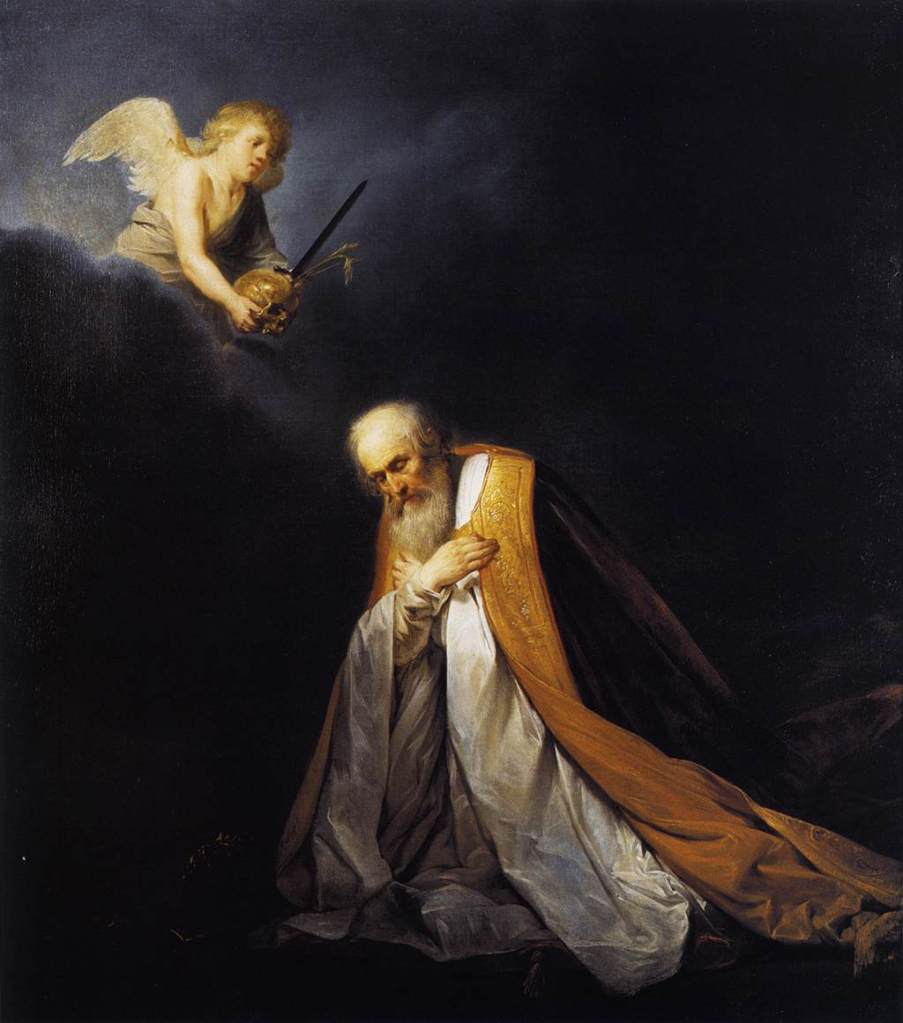
By Pieter de Grebber – King David in Prayer (ca. 1635-1640), Public Domain, https://commons.wikimedia.org/w/index.php?curid=15144058

Comments on the Text

The opening of chapter two apparently begins the book anew. David (not “King David,” one notes) is old, yet still in power. This duplication of the end of David’s reign carries a much different tone than the preceding in some passages. The first twelve verses of the chapter can be divided into a few sections. Verses 1 and 10-12 are the narrated frame of David’s lengthy speech, which appears in 2-9. This speech can easily be divided into four unequal parts: 2-4 recount David’s admonishing Solomon to act according to biblical precepts; 5-6 announce David’s posthumous revenge on Joab; 7 express his favor to Barzillai and his sons; and 8-9 mandate Solomon’s avenging the dishonor of Shimei on his father David. The first part of the speech takes a decidedly different tone than the rest, with the possible exception of the referent to Barzillai. One notes that two revenge notices surround the one gracious notice, suggesting perhaps a compositional intention, but that is hardly provable.

The vernacular of this opening scene of chapter 2 is strongly reminiscent of Deuteronomistic theology, i.e., theology rooted in the tenets of the book of Deuteronomy. More specifically, this Deuteronomistic terminology and theology appears most prominently in verses 1-4 and is largely absent in the rest of the speech. David’s opening demand of Solomon is similar to God’s demand of Joshua in Joshua 1.

Two of the three elements provide the structure for the end of the chapter, at least as it is preserved in the Hebrew version. (The Greek version of this chapter is fundamentally different, but more on that in a later post.) The speeches against Joab and Shimei frame the speech favoring Barzillai. The end of the chapter, vv. 28-43a, report Solomon’s fulfilling these commands, albeit with no further mention of Barzillai, whether here or elsewhere in Kings. When I read these verses, they seem to be an interpolation between verse 4 and verse 10, introduced later to justify the subsequent executions (or murders, if you prefer). Conspicuously absent from David’s proclamation of vengeance is Adonijah, particularly since he is the focus of the two episodes surrounding David’s lengthy speech.

The conclusion of this section ends David’s life. The narrator informs the reader where David was buried and reminds the reader how long and where he reigned. Finally, the notice follows, this time from the narrator, that Solomon sat on David’s throne. After this notice the text takes a long detour about Solomon’s shoring up his position as king. At the end of chapter 2, there is another notice (2:43b) that Solomon had established the kingdom in his hand. Taken together, these pieces suggest to me, on a superficial level even, that someone added 2:13-43a, probably in stages, to chapter 2. These expansions could have been the reason for an even later insertion of vv. 5-9, which justify Solomon’s execution of the others. However, they could have been included at the same time. That issue still needs to be resolved.

Translation of 1 Kgs 1:41-53 (MT)

41. And Adonijahu heard (and all those who were summoned with him and they had finished eating). And Joab head the sound of the horn and said, “why is the city’s voice grumbling?”
42. While he was still speaking, dude! Jonathan ben Abiathar (the priest) came and Adonijahu said, “come, for a mighty man are you and good tidings you will bear!”
43. And Jonathan answered Adonijahu, “truly, our lord King David has made Solomon king.
44. “And the king sent with him Zadok the priest and Nathan the prophet and Benaiahu ben Jehoiada and the Cherethites and the Pelethites and they had him ride upon the king’s mule.
45. “And they anointed him, Zadok the priest and Nathan the prophet, to (be) king at Gihon and they went up from there happily and agitated the city. This is the sound that you heard.
46. “And also Solomon sat on the throne of the kingdom.
47. “And also the servants of the king came to bless our lord King David, saying ‘may your God make the name of your son Solomon greater than your name and increase his throne more than your throne.’ And the king prostrated on his bed.
48. “And thus spoke the king, ‘blessed is Yhwh, Israel’s God, who gave today the one sitting on my throne and my eyes are seeing (it).'”
49. And they trembled and got up, all those who had been called to Adonijahu, and they went, each to his path.
50. And Adonijahu was afraid from before Solomon and he got up and went and grasped the horns of the altar.
51. And it was told to Solomon, saying, “dude! Adonijahu fears King Solomon and, dude! He has grasped the horns of the altar, saying, ‘King Solomon should swear to me just as today that he will not kill his servant with the sword.'”
52. And Solomon said, “if he will be to me a son of honor, nothing will fall from his hair to the ground. But if wickedness is found in him, he will die.”
53. And King Solomon sent and let him be brought down from on the altar and he came and did obeisance to King Solomon. And Solomon said to him, “go to your house!”

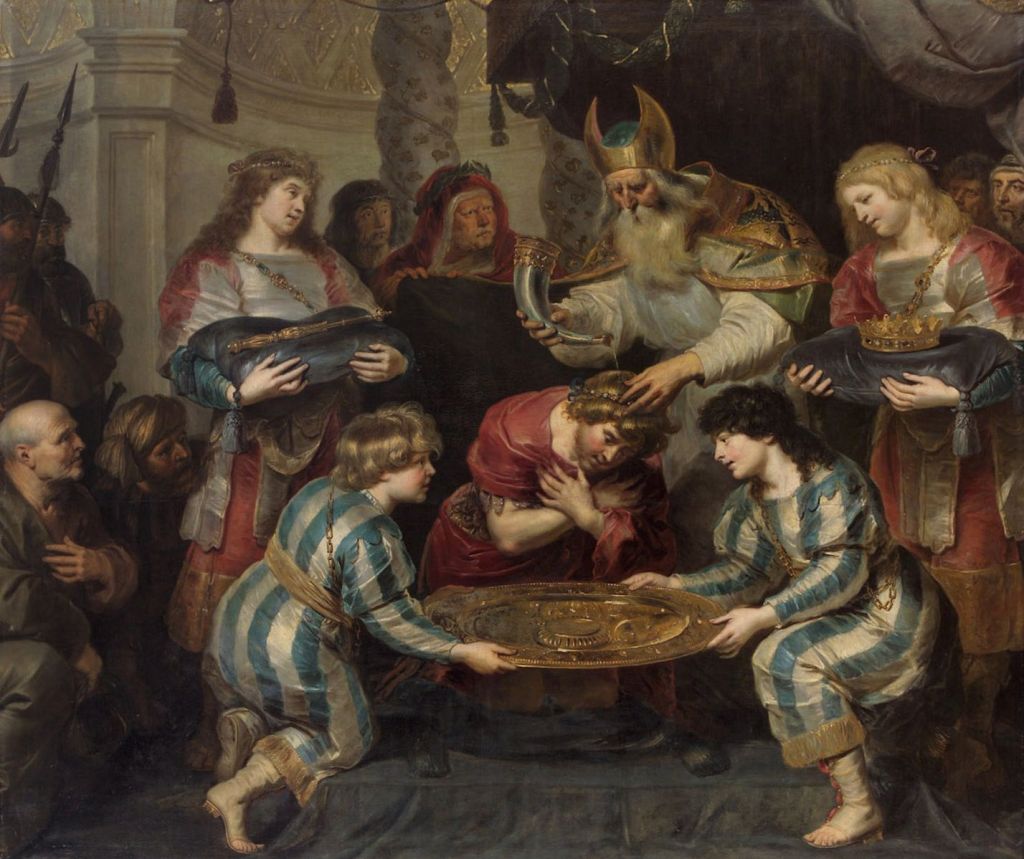
Cornelis de Vos. The Anointing of Solomon. Ca. 1630. Kunsthistorisches Museum, Vienna. Public Domain. [Wikimedia Commons]

Comments on the Text

Verse 48 opens again with a singular verb and a plural subject, making the syntax somewhat awkward, particularly with the reference to their finishing eating. Why is that relevant? First Adonijahu hears, though it is not clear what. Then Joab hears, and here it is clear: he hears the sounds of horns and, based on his inquiry, the uproar in the city.

In response to this, suddenly and conveniently (from a narrative perspective) the son of the priest allied with Adonijahu arrives from off of the scene. Adonijahu presumes that he will provide an auspicious report of what is going on and inquires what is up.

His response is prompt and initially to the point: King David has made Solomon king. The description of King David as “our lord” can be understood in a variety of ways. Does this mean that Adonijahu never supposed himself a usurper? Is this comment to undercut his position? Is this reference to protect him from people who would want to accuse him of usurpation? No evidence is provided, but it is interesting that here King David is “our lord” to the people assembled around Adonijahu.

Verses 44-45 more or less describe the scene from 38-40. The real change comes in verse 46, which opens a whole passage of material that the reader has thus far heard nothing about other than in Nathan’s plan. This is the first time the reader hears of Solomon sitting on the king’s throne. The ductus of this new material continues in verses 47-48, which include new blessings and speeches from the people involved in Solomon’s accession. Suddenly the king is there and expresses his thanks that he lived to experience this event. After citing the king’s speech, Jonathan concludes his recitation of recent events.

The reaction to this speech is fear and abandonment in vv. 49-50. First Adonijahu is abandoned and then he flees to the altar. This altar probably refers to the one in 2 Sam 24, as no other altar has been mentioned thus far. Presumably Adonijahu thinks he will be safe in front of the altar. While it works in this case, this view is somewhat shortsighted, as will become clear in the next chapter.

The episode concludes with Solomon, now officially called the king (though not exclusively), reacting to Adonijahu in vv. 51-53. Solomon promises only to kill him if wickedness is found in him. The reader knows what this means and this expectation is fulfilled in the next chapter. With this, power has now officially transferred from David to Solomon. It should have been David as king who reacted to Adonijahu, but this task is left to Solomon. David never says anything about it in the biblical story before his death. He never mentions this episode with Adonijahu. David only does two more things in this recounting of his reign before Solomon ultimately takes over: 1) he admonishes Solomon and 2) dies.

  • Welcome to my blog!

    I hope you find the material here both entertaining and informative. Or at least one of those two. Or neither. Welcome to my blog!
  • Enter your email address to subscribe to this blog and receive notifications of new posts by email.

  • Follow Jonathan Robker: Exegete, Critic, Cook on WordPress.com
  • Archive

  • Twitter Timeline