
Translation of 3 Reigns 2:28-35 (1 Kgs 2:28-35 LXX)

28. And the report came to Ioab sond of Sarouias, for Ioab was inclined after Adonias and after Solomon he did not incline. And Ioab fled to the tent of the Lord and he grasped the horns of the altar.
29. And it was reported to Solomon, saying that “Ioab fled to the tent of the Lord. And dude! He grapsed the horns of the altar.” And Solomon sent to Ioab, saying, “What is for you, that you fled to the altar?” And Ioab said, “Because I was afraid before you, and I fled to the Lord.” And Solomon, the king, sent Banaias son of Iodae, saying, “Go and kill him and bury him.”
30. And Banaias son of Iodae went to Ioab to the tent of the Lord and said to him, “Thus said the king: ‘Come out!'” And Ioab said, “Not will I come out, for here I will die.” And Banaias son of Iodae returned and he spoke to the king, saying, “Thus has Ioab spoken and thus he answered me.”
31. And the king spoke to him, “Go and do to him just as he has said and kill him and bury him. And you will remove today blood, which Ioab poured out for no reason, from me and from the house of my father.
32. “And the Lord returned the blood of his injustice to his head, how he encountered two people, more righteous and better than him, and killed them with the sword. And my father David did not know their blood, Abenner son of Ner (the chief officer of Israel) and Amessa son of Iether (the chief officer of Judah).
33. “And the blood returned to the head of his seed for eternity. And for David and for his seed and for his house and for his throne may there be peace for eternity from the Lord.”
34. And Banaias son of Iodae fell upon Ioab and killed him and buried him in his house in the desert.
35. And the king set Banaias son of Iodae in place of him over the military. And the kingdom was established in Jerusalem. And Sadok the priest, the king set as first priest in place of Abiathar.
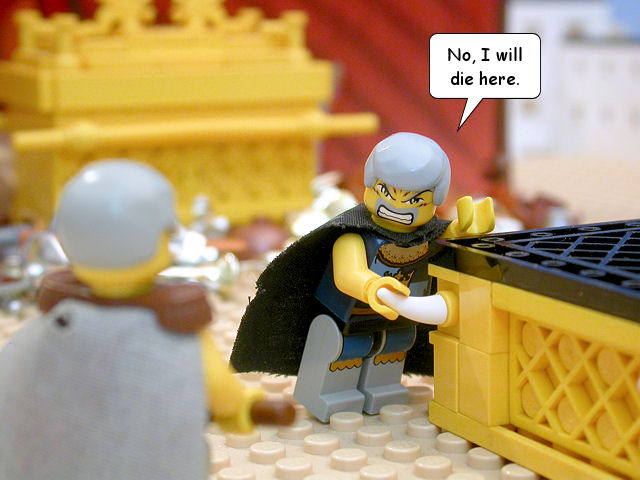
1 Kgs 2:30 according to The Brick Testament.

Notes on the Text

A lengthier passage with time with a number of differences between the Hebrew and Greek versions, some of them potentially relevant for understanding the diachrony of Kings.

Verse 28 includes the addition of patronymic for Ioab in Greek. Since this is the first time that he has been mentioned since the translation technique changed in 2:12, one wonders if this might evince and older division of the books at that point (as in the Lucianic recension and Chronicles). Ioab did not support Solomon in Greek, whereas in Hebrew the reference is to Absalom, the last son of David before Adonijah who supposedly rose up against his father. To me, this looks like the Hebrew is attempting to conform the text better to its immediate context: the dispute between Solomon and Adonijah. The difference between the names Absalom and Solomon in Hebrew is not as marked in the Hebrew, making it at least possible that the Greek reading resulted from an error.

Solomon’s title missing in the first instance of his name in the Greek of v. 29. This variant might have implications for appreciating the diachrony of these chapters, in that the change between Solomon and King Solomon could have relevance. It is reiterated in the Greek of this verse as well that Ioab grabbed the horns of the altar. This plus in the Greek could represent a gloss for narrative consistency. Then there is a lengthy plus in the Greek that includes a first discussion between Solomon and Ioab before Solomon sends Banaias to kills Ioab. This likely went lost in the Hebrew text due to parablepsis, when a scribe oversaw the material between the two phrases beginning “Solomon sent.” Finally, King Solomon’s command in Greek includes the order to bury Ioab. This plus perhaps represents an attempt to make the story more consistent, with the conclusion in v. 34 now better matching King Solomon’s command.

The Greek in v. 30 adds Banaias’s patronymic each time he is mentioned in this verse, thus including his patronymic in every circumstance in which he is mentioned. This is unusual, but I have no ready explanation for it. Verse 30 also includes the name “Ioab” as the subject when he answers Banaias, perhaps a clarifying gloss. In this version, Ioab is also more explicit in that he states that he will not come out instead of just saying “no” as in the Hebrew and the divinely inspired Brick Testament (see above). This longer reading could also be a gloss. The Greek of this verse includes a different expression for how Banaias began his speech to Solomon. Likely the Greek version reflects an older and better Vorlage and the Hebrew text is corrupt, since it does not make much sense. Probably something was overlooked in the Hebrew tradition leading to the curious syntax as it now stands (“Benaijah brought back with the king a word [direct object], saying…”).

The king’s command is more explicit in the Greek of verse 31, including the first imperative “go!” and the preposition with its object “to him” after the imperative “do!”. The first plus likely represents a longer version that disappeared in the Hebrew due to haplography (the repetition of לך after מלך). The second difference is not as easy to explain as the result of an error in either direction. It is also explicitly stated in the Greek of this verse that the fulfilment of these commands should occur “today.” It remains unclear which version here might be the older of the two. It is possible that it was overlooked in the Hebrew at some point and went missing due to the similarity of several letters (היום followed by דמי), but this is quite speculative.

The Greek of v. 32 describes the “blood of his injustice,” an unusual phrase that could represent a distinct Hebrew Vorlage. Again, it remains unclear what errors might have stood behind such a difference in the versions, which could suggest that the Greek represents and interpretive gloss. The Greek here also notes that David knew nothing of the blood of those that Ioab killed. The Greek syntax is curious, with two direct objects in apposition, which might speak to its status as the older reading.

The Hebrew of v. 33 is more explicit about the blood being brought back upon Joab’s head, mentioning him by name. Perhaps that represents explicating gloss, commending the Greek as the older version.

The first phrase of v. 34 varies substantially between the Greek and Hebrew versions. The Greek has one fewer verb than the Hebrew and includes Ioab’s name as to whom Banaias “encounters.” The end of the verse notes in the active voice that Banaias buried “him,” not passively that Ioab “was buried” as in the Hebrew. Likely the single letter ו went missing after the ר in the Hebrew text, suggesting that the Greek is older.

There is a major difference in v. 35 between the Hebrew and the Greek. The Hebrew consists of two roughly parallel phrases about the king’s replacing personnel: first Joab and then Abiathar. In the Greek, there is another sentence between these two phrases: the kingdom was established in Jerusalem. This phrase sounds a lot like 2:12, which could have substantial literary-critical implications. It is unlikely that this sentence was accidentally included in the Greek, and probably just as unlikely that someone unintentionally left it out of the Hebrew. That is, I think that the Greek represents an older version and that someone intentionally deleted this phrase from the Hebrew. Finally, in this verse, the Greek includes the title “first priest” for Sadok. As far as I see it, this is the only occurrence of this term, increasingly the likelihood that it is an explanatory product of the translator and was not present in the Vorlage.
Translation of 3 Reigns 2:26-27 (1 Kgs 2:26-27 LXX)

26. And to Abiathar, the priest, the king said, “get yourself to Anatoth in your countryside! For a man of death are you on this day. And I will not kill you, for you carried the ark of the covenant of the Lord before my father and because you were afflicted with trials, those that afflicted my father.”
27. And Solomon cast out Abiathar from being priest of the Lord, fulfilling the word of the Lord that he had spoken about the house of Eli in Selom.

Notes on the Text

In spite of the brevity of this text, there are a number of differences between the Greek and Hebrew versions. All of them (beyond orthography) are in v. 26.

First, the Greek emphasizes “you” after the imperative in v. 26. I find it difficult to imagine that this represents a distinct Hebrew Vorlage (cf., however the לך לך in Gen 12:1 and 22:2, neither of which has a Greek translation similar to the phrase here).

The phrase “on this day” is transposed behind the conjunction “and” in the Hebrew. Most likely there is an error in the Hebrew text. Otherwise, one would expect a Hebrew story at some point that explained how Solomon killed Abiathar. In the Hebrew version he states, “on this day I will not kill you,” after all, suggesting that he could and/or would do it some other day. This never happens in the versions of Kings.

Instead of the curious phrase “the ark of the Lord Yhwh,” the Greek reads “the ark of the covenant of the Lord (=Yhwh).” In this case the Hebrew likely again represents an errant text. It looks like the form to be read in the Hebrew was included adjacent to the term as written (i.e., the Qere-Kethib elements stand next to each other in the text). The question remains open as to whether the Greek stems from a variant Hebrew reading or was added by the translator.

Finally, the Hebrew includes the name “David” before “my father.” I regard this as adding emphasis to the figure David in the Hebrew version and would consider strongly the possibility that this presents a later addition.

Translation of 3 Reigns 2:13-25 (1 Kgs 2:13-25 LXX)

13) And Adonias, son of Angith, came to Beersabee, mother of Solomon, and bowed to her. But she said, “is your coming (in) peace?” And he said, “peace.
14) “A word for me to you.” And she said to him, “speak.”
15) And he said to her, “you know that for me was the kingdom and upon me placed all Israel its face to (be) king. But the kingdom was turned and became for my brother, for from the Lord was it for him.
16) “And now, one request I request from you. You should not turn away your face.” And to him Beersabee said, “speak.”
17) And he said to her, “speak now to Solomon, the king, for he will not turn away his face from you. And he will give me Abisak the Somanite for a wife.”
18) And Beersabee said, “good. I will speak on your behalf to the king.”
19) And Beersabee went to King Solomon to speak to him about Adonias. And the king arose in meeting her, and he kissed her and sat upon his throne. And a throne for the king’s mother was set up, and she sat on his right.
20) And she spoke to him, “one small request I am requesting from you. Not should you turn your face.” And to her the king said, “request, my mother, for not will I turn you away.”
21) And she said, “give, now, Abisak the Somanite to Adonias, your brother, for a wife.”
22) And Solomon, the king, answered and said to his mother, “to what end have your requested Abisak for Adonias?” And you should request for him the kingdom! For this on is my brother, greater (= older) than me and for him were Abiathar the priest and for him was Joab son of Sarouias, the commander-in-chief, a companion.”
23) And King Solomon swore by the Lord, saying, “this shall God do to me and this he shall add, for against his life has Adonias spoken this word!
24) “And now, as the Lord lives, who prepared me and set me upon the throne of David, my father, and he made me a house, just as the Lord had spoken, for today Adonias will be put to death.”
25) And Solomon, the king, sent by the hand of Banaias son of Iodae and he killed him and Adonias died on that day.

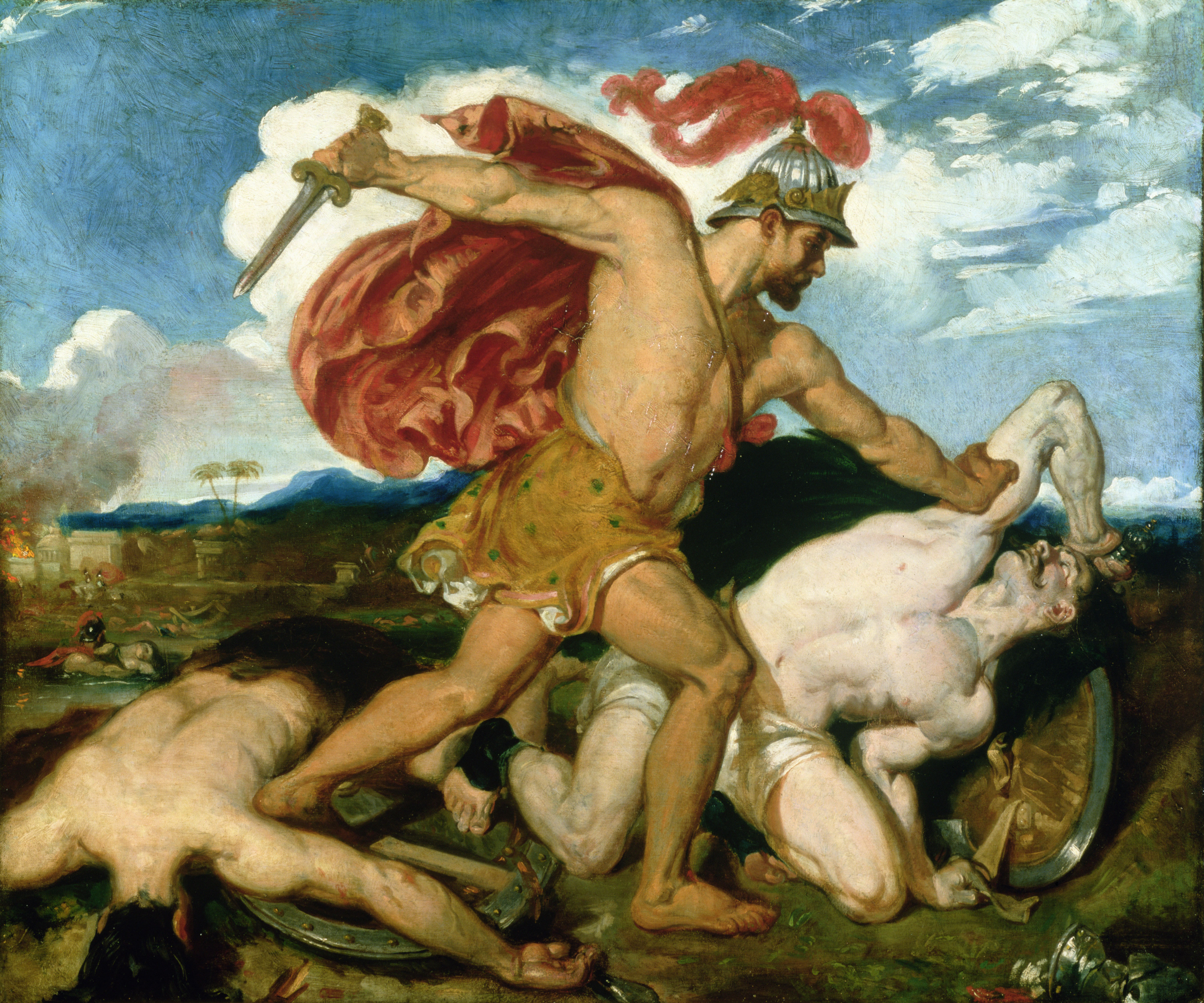
“Benaiah” by William Etty (1829). York Art Gallery. Public Domain

Comments on the Text

This passage presents a number of differences between the Hebrew and the Septuagint. As per usual, I will be leaving aside the orthography of the names in these considerations.

One recurrent issue in this passage is the addition of indirect objects (or objects of prepositions) regarding the audience of lines of dialogue. The Greek contains no fewer than four more instances of this in these verses than in the Hebrew (1x each in vv. 14, 15, v. 17, and 20). While it is possible that in some or all of these instances that the Greek reflects a variant Vorlage, to me it seems just as likely that the addition of these indirect objects serves to distinguish who is speaking. Without these objects in the Greek text, it would be somewhat unclear who is speaking to whom. That is because, different than in Hebrew, the Greek does not differentiate between the masculine and feminine in the verb forms in the third person singular. So, while it remains possible, that the Greek text represents a Hebrew version distinct from that of the Masoretic text, I find it difficult to affirm that with any great degree of certainty in these cases. It’s certainly possible that the Greek stems from a variant version, but it is hardly necessarily so.

Another repeating issue is whose face should be turned away. In vv. 16 and 20, the Greek reads “your face” and the Hebrew reads “my face.” This seems to imply some insecurity about the idiom as it relates to making a request. What was the sign of the rejection of a request? The turning of the inquirer’s face or the face of the one being asked? There is no clear answer to this question in this text.

Additionally, there are a number of other minor and larger differences between the Hebrew and Greek versions.

Verse 13 in Greek mentions Adonias bowing to Beersabee, which is something missing from Solomon’s engaging with her in v. 19 (in the Greek version there, Solomon kisses her instead). These differences seem unlikely to have resulted from an error, suggesting that someone changed the text in one direction or the other. The Greek text of v. 14 is missing “and he said” in its opening. In this case, I would argue that the shorter reading likely is older and that the addition of “and he said” crept in as a result of dittography (n.b. the two other cases of this Hebrew term in vv. 13 and 15).

Verse 16 in Greek explicitly names Beersabee as the subject of the final clause. The reference is only implicit in the Hebrew. At first glance, one might think that this presents a clarifying addition similar to the indirect objects noted above, but in this case, the Greek also contains an indirect object as in the Hebrew (object of a preposition, in that case), making the need for further clarification extraneous. The situation remains murky, but it seems that we have a duplication in vv. 14b and 16b. That could suggest that the Hebrew text removed her name for consistency, but that is not entirely clear here.

Beyond the kissing instead of prostrating in v. 19, the verb for setting up the throne is passive in G. This hardly presents a real variant and can be resolved merely through a repointing of the same consonantal text. That is, the Hebrew Vorlage of the Greek version was probably identical to the current Hebrew version, but understood the verb as a passive whereas the Masoretes made it an active verb.

Verse 21 in Greek includes and element that is not present in the Hebrew. Most likely this reflects the Hebrew particle נא (“please, indeed”), common in requests; cf., e.g., v. 17. The most likely explanation is that it has gone missing in the Hebrew text due to an oversight between תתן and את (haplography). The Greek probably represents an older, though slightly longer text in this case.

The Greek of v. 22 contains a number of differences when contrasted with the Hebrew. First, it lacks “the Somanite” as a descriptor for Abishag. Since the Greek version of this verse presents the only case in the Bible in which the name Abishag is mentioned without “the Shumanite,” the most likely explanation is that someone added it to the Hebrew for the sake of consistency after the translation of the Septuagint. The syntax of the last phrase is much clearer in the Greek, which contains several extra elements. Each of the names is preceded by the preposition “to/for” in Hebrew, making this text difficult to understand. It is probably the result of an error. The reference to Joab also includes his office in addition to his patronymic in Greek, as well as the modifier that he was “a friend” or “friendly” to Adonias. Perhaps these elements were lost due to an oversight in the Hebrew due to the similarities with the opening of the next verse. I’m not certain about this though and it’s just an idea.

Verse 24 in Greek includes a further reference to “the Lord” regarding the construction of Solomon’s house. While this could present an attempt to make the text more precise, ultimately it makes the syntax more clunky, suggesting that it may be original and then later removed in the Hebrew.

Finally, the last verse of this passage, v. 25, in Greek essentially duplicates Adonias’s death. This occurs because it includes his name in the final phrase. With that, Benaias kills him and he dies. The verse ends with the additional notices that his death occurred “on that day.” This likely presents an adaptation to better match the context of v. 24, in which King Solomon announces that he should die on that die. Someone, either LXX or its Vorlage may well have seen a need to provide a strengthened notion that this promise had indeed been fulfilled.

  • Welcome to my blog!

    I hope you find the material here both entertaining and informative. Or at least one of those two. Or neither. Welcome to my blog!
  • Enter your email address to subscribe to this blog and receive notifications of new posts by email.

  • Follow Jonathan Robker: Exegete, Critic, Cook on WordPress.com
  • Archive

  • Twitter Timeline