
Translation of 2 Sam 25:22-27 (1 Kgs 1:22-27 Ant.)

22) And dude! She was still speaking with the king, and Nathan the prophet came.
23) And they reported to the king, saying, “Dude! Nathan the prophet!” And Nathan came before the kin, and he bowed to King David on his face upon the ground.
24) And he said, “You, lord king, have you spoken, saying, ‘Ornia will reign after me and he will sit upon my throne?’
25) “For he went down today and sacrificed calves and sheep in multitude, and he called all of the sons of the king and the chief officer Ioab and Abiathar the priest. And dude! They are eating and drinking before him and they said, ‘Long live king Ornia!’
26) “And me, your servant, and Saddouk the priest and Banaias son of Ioad and Solomon your son they did not call.
27) “And if because of my lord the king this thing has come to be, and to what end [lit. because of what] have you not made known to your servant who should sit upon the throne of my lord the king after him?”
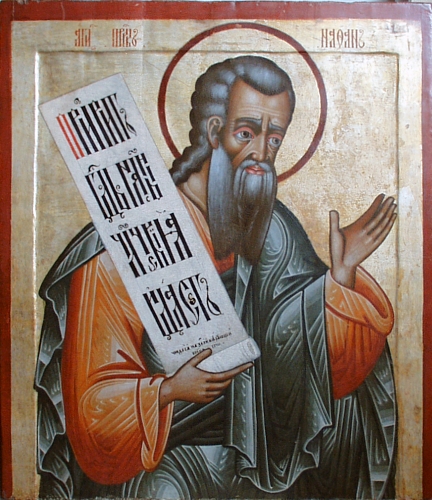
Iconostasis of Transfiguration church, Kizhi monastery, Karelia, Russia. 18th cent. Public Domain. WikimediaCommons.

Comments on the Text

The only difference between Ant. on the one hand and MT and LXX on the other in v. 22 is the Transposition of “still.” Likely LXX presents a revision toward a Hebrew Vorlage like MT.

Verse 23 contains a number of distinctions. The first verb form in Ant. has a different preposition appended—which does not really change the meaning in this case—and is an active plural in Ant., but a passive in LXX. In this case, Ant. more accurately reflects MT, suggesting that LXX cannot be a revision to a text like MT and may in fact attest the Old Greek in this case. The LXX is missing the verb “saying,” but Ant. attests it and matches MT again in this case, suggesting that LXX could be the older reading. Ant. includes “Nathan” as the subject who is entering, which is not in MT or LXX. This can be regarded as a transposition from the next verse. The phrase translated “before” is different in the Greek versions; LXX reflects each element of the Hebrew suggesting that it represents a revision. Ant. includes the name “David” in referring to whom Nathan bowed. The Greek versions do not read “upon his nose” as in the MT, but each reflects the Hebrew לפני in the same manner as previously in the verse. Whether those distinctions permit the reconstruction of a variant Vorlage in that case is difficult to tell.

In verse 24 Ant. lacks the subject “Nathan,” which does appear in LXX and MT. It seems reasonable to regard its absence here as the result of a transposition to the previous verse. Ant. transposes the second-person subject “you” in Nathan’s speech to precede the vocative. The vocative in Ant. lacks “my” as found in MT and LXX. Since LXX both matches MT and is the easier reading in this case, one can regard its reading as the result of a later recension. The verb for speaking is a perfect in Ant. as opposed to an aorist in LXX, and Ant. attests an introduction to the speech missing in LXX and MT. Ant. has a different preposition than LXX for “after.” As many of the distinctions in Ant. differ (more) from MT, it is quite possible that it better reflects the Old Greek in several instances in this verse.

The verb for “sacrifice” in v. 25 is a perfect in Ant. and an aorist in LXX. LXX lists three kinds of animals, consistent with MT, suggesting that it might present a revision in this reading. There is no obvious reason for Ant. to be missing the third animal category. Ioab’s title in Ant. varies from LXX, but is consistent with the other translations of this term in Ant. LXX more accurately reflects the Hebrew in these cases, again suggesting that it stems from a revision. After the “dude,” both Ant. and LXX—though they differ—present an item missing from MT, likely a המה (“they”) that has since been lost in Hebrew and should probably be restored. The verbs for eating and drinking are finite in Ant. and participles in LXX, which matches MT, again suggesting that LXX is a revision.

Ant. lacks an emphatic at the opening of v. 26 and, in this case, matches MT. That suggests that LXX may be Old Greek in that case. Solomon is called “your servant” in LXX and MT, but “your son” in Ant. The final verb in the verse is a perfect in Ant. and an aorist in LXX.

The last verse this week opens with a conjunction missing in MT and LXX. The opening of the second phrase in Ant. includes the element “to what end” that is missing in both MT and LXX. Deciding these cases is particularly difficult, but nothing speaks against Ant. representing the OG here.
2 Sam 25:15-21 (1 Kgs 1:15-21 Ant.)

15) And Beersabee went to the king into the bedroom. And the king [was] very old. And Abisaak the Somanite [was] serving the king.
16) And Beersabee bowed down and did obeisance to the king. And to her the king said, “What is for you?”
17) And Beersabee said, “O lord, o king, you swore by the Lord God saying that ‘Solomon, your son, he will reign after me and he will sit upon my throne.’
18) “And now, dude! Ornias has begun to reign. And you, o lord, o king, do not know.
19) “And he sacrificed calves and sheep in multitude. And he called all the king’s sons and Abiathar the priest and Ioab the chief general. And did this thing come about through my lord the king?”
20) “For the eyes of the whole people [are looking] to you to tell them who will sit upon the throne of my lord, the king, after him.
21) “And it will be, at my lord the king’s sleeping with his fathers, and I and my son Solomon will be sinners.”

Notes on the Text

There aren’t too many differences in the text this week and really only one of them is substantial. Let’s begin with v. 15. Rather than read the term “chamber” like LXX, Ant. has “bedroom.” Two matters are worth noting in this regard. First, the more general “chamber” matches the Hebrew more closely. Second, the term used here for bedroom has the same root as sexual intercourse, which makes the mention of Abisaak quite awkward. Both of these reasons favor regarding Ant. as the older reading here. The finite verb “was” does not appear in the final phrase of this verse in Ant. Since there is no term for this in the Hebrew, it’s appearance in the kaige version of LXX is unusual, meaning that LXX might be the original reading in that case.

Verse 16 attests only one variant in Ant.: it includes the indirect object “her.” While this does not appear in the Hebrew or LXX, it is widely attested in other ancient translations, making it at least viable as the original reading. LXX would have been corrected to match the Hebrew, consistent with kaige technique.

The Antiochene text of v. 17 includes “Beersabee” as the named subject. This can be regarded as an explanatory gloss, since the verb alone would be ambiguous in Greek in terms of Gender, which is not the case in Hebrew. (LXX has its own solution to that ambiguity, in which it includes a feminine article and an postpositive conjunction to distinguish who is speaking.) The vocative phrase in Ant. is different than other witnesses: the Hebrew only reads “my lord,” whereas LXX reads “my lord, o king.” I tend to favor LXX as the older reading in this case, since it reads somewhat more awkwardly and does not match the Hebrew. Ant. uses a different preposition for “by,” that appears to contravene the standard equivalent found in LXX. That could mean that LXX represents a change from an older Greek version still attested in Ant. In LXX and MT, the king swore by the Lord “your God” to “your servant.” In this case, there’s probably some corruption: either the Ant. text (or its Vorlage) accidentally skipped a word or MT and LXX accidentally added one; cf. לאמתך and לאמר. Since this error, irrespective of direction, ir more likely in Hebrew, I tend to favor dittography in MT and then in LXX as opposed to Haplography in Ant. Ant. emphasizes the subject of reign with an extra “he.” I imagine that this represents a stylistic change so that both phrases about Solomon’s future match formally.

Verse 18 has a distinct verb forms for “reign” in the Greek versions. Since LXX is more consistent in its translation, that makes it a likely later reading. Again, the “my lord” in LXX and MT is only “lord” in Ant. The consistency of MT and LXX could indicate that LXX presents a revision toward MT. The “and you” in Ant. matches the LXX , but represents ועתה in MT. MT is likely an error from ואתה.

There are only two kinds of animals listed in v. 19 Ant., whereas the other versions have three. Ioab’s title is different from the LXX, which more literally matches the MT. The whole final phrase is distinct from LXX and MT (cf. v. 27). In Ant. this phrase strongly resembles v. 27 but it cannot be copying from there, since there are some distinctions between the semantics. That could imply that Ant. attests an older Vorlage since lost in the Hebrew.

The first phrase of v. 20 in Ant. is substantially different from and shorter than the other versions. That could suggest that it is older. Of particular significance in this case is that Ant. perfectly matches Hebrew syntax, suggesting that it cannot be a revision within the Greek text.

Similarly in v. 21 the reference to sleeping with the fathers begins differently in Ant. LXX unsurprisingly matches MT, but Ant. represents a distinct Hebrew reading, with the preposition ב instead of כ. Ant. could represent an older, or at least distinct, Hebrew reading since lost. The final verb in LXX more accurately matches MT than does Ant. Each Greek version features a distinct term for “sinners.” The reading in Ant. does not appear anywhere in LXX, suggesting that it might be an older reading.

Translation of 2 Sam 25:11-14 (1 Kgs 1:11-14 Ant.)

11) And Nathan went to Beersabee, the mother of Solomon, and he said, “Have you not heard that Ornias, son of Angeith, has become king, and our lord David does not know?
12) “And now, indeed I will advise you advice so that you will save your life and the life of your son Solomon.
13) “And come! Go to the king, David, and you will say to him, ‘Did you not, o lord king, swear to your servant by the Lord God saying that, “Solomon your son, he will reign after me and he will sit upon my throne? And why then has Ornia become king?”‘
14) “While you are still speaking there with the king, I will enter after you and I will fill your words.”

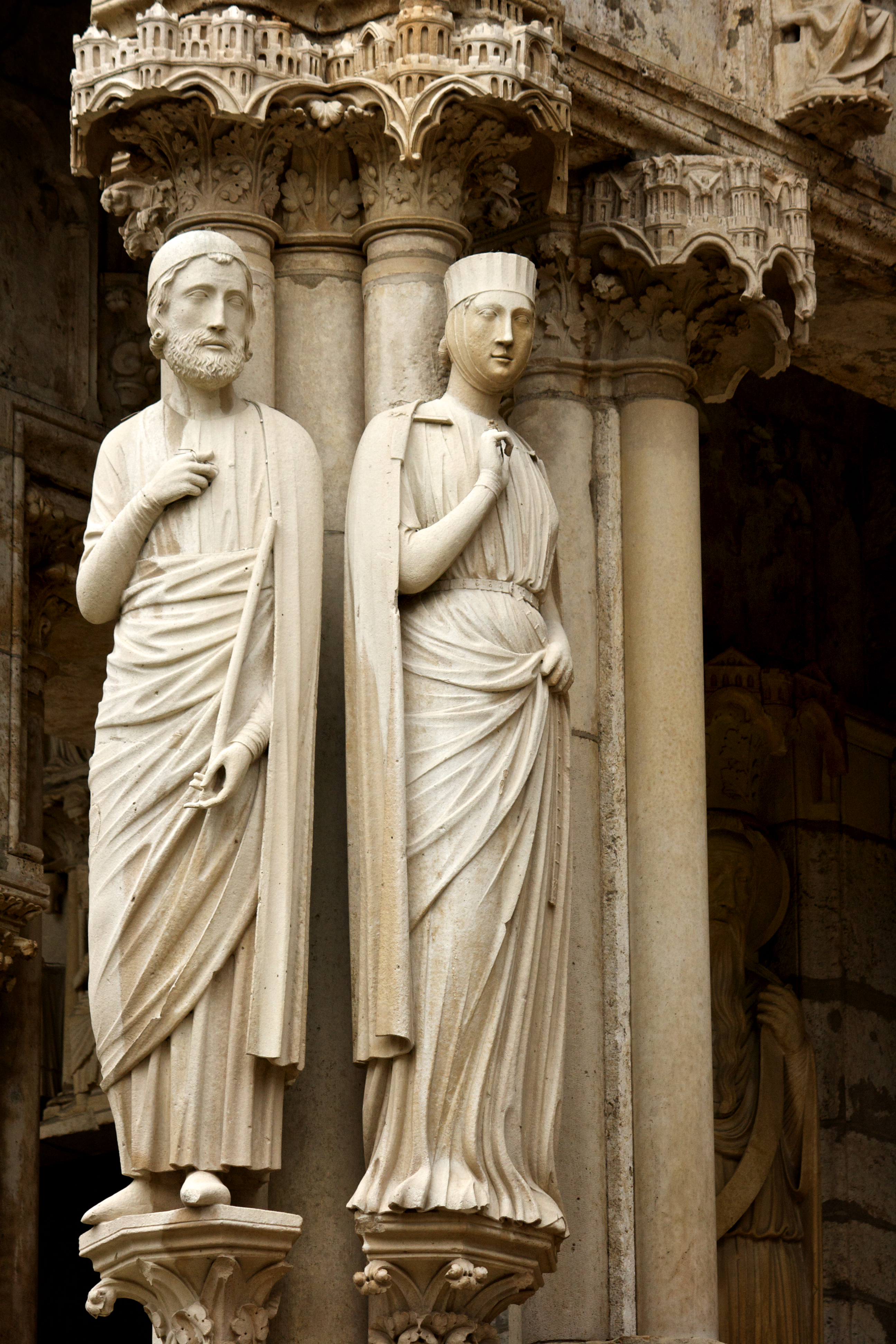
Nathan and Bathsheba. North Portal, Cathédrale Notre Dame de Chartres, France. (c) 2009 Nick Thompson. CC BY-NC-SA 2.0

Verse 11 attests some significant differences. First, it opens with a notice that Nathan went to Bathsheba, which is missing in the other versions, before he spoke to her. This distinction appears rather dramatic, but it really only requires two minor variant readings. The most significant variant is the first verb, which the Lucianic text records as “went” as opposed to “said” in LXX and MT. The second difference is less dramatic, in that it merely represents a different form of the verb “to say.” If the Lucianic text is older in these cases, the distinction probably developed from a change in the form of the second verb leading to a change in the first in MT and LXX. That is possible, but by no means certain. The other difference in the Lucianic text distinguishes it from the LXX, but both accurately reflect MT. Rather than read an aorist, noting that Ornias “reigns,” the Lucianic text reads a perfect, “has become king.” While this may be important for the reconstruction of the Old Greek, it does not impact any presumed Hebrew Vorlage of the Greek text. The phrasing in LXX in every variant in this verse is consistent with kaige translation technique, suggesting that the Lucianic text may well attest the Old Greek in this case. That means that the opening of the verse could in fact represent the Lucianic text’s transmission of an older Greek version stemming from a variant Hebrew text to that known today.

The next verse, v. 12, also presents a few differences from the LXX and Hebrew text. Since the LXX is identical to the MT, these differences can be handled together. First, the Lucianic text does not have the imperative “come” after “now,” making it the shorter and preferable reading. Rather it has the element “indeed” there, which in the LXX has been transposed to match its position in MT. The phrasing in the Lucianic text combines the sentences more explicitly, using a conjunction that means “so that” rather than the more paltry “and” of the Hebrew and LXX. The verb in the verse’s final phrase in Greek is distinct between the LXX (“deliver”) and the Lucianic text (“save”). In this case again, the LXX more explicitly reflects the MT, suggesting that it is an editorial revision away from something like the Lucianic text. Nonetheless, really only the absence of the first imperative in the Lucianic text might indicate a different Hebrew Vorlage. N.b. that verse 13 opens with precisely this term in all three versions (albeit with a conjuction in the Lucianic text).

A number of differences appear in v. 13 as well, this time with some theological relevance. The Lucianic text opens the verse with conjunction that is missing in the other witnesses. Perhaps this represents a transposition from before the second imperative as attested in the Hebrew text and missing in LXX. Further, Nathan introduces Beersabee’s indirect speech in a manner more consistent with Hebrew usage in MT and LXX, adding the element “saying.” Likely it represents an addition in those cases. More importantly, the Lucianic text includes the addition of “by the Lord God” after the recounring of Beersabee’s swearing. This makes her statement naturally more impressive, which could indicate that it is an addition in the Lucianic text. However, it is more likely that the other witnesses removed it, since this event is never recounted elsewhere in the Bible. That makes Nahtan and Beersabee perhaps liars, even blasphemers in the Lucianic version. The Lucianic text emphasizes Solomon with an additional “he” before the indication that he will reign. This verb form, for reigning, matches that in v. 1 in each Greek case. For the most part again, I would go so far as to presume that the differences between the LXX and the Lucianic recension favor the Lucianic text as closer or identical to the Old Greek. This would have one important distinction (and probably some minor ones) regarding the presumed Hebrew Vorlage: the inclusion of a reference to “the Lord God” as a witness to the swearing lends substantially more theological weight to the whole passage of 1 Kgs 1.

The Greek variants in v. 14 again suggest that LXX has been corrected ot match a text like MT. The opening of the verse in the Lucianic version lacks the exclamation “dude!” that is present in the MT and even includes the conjunction preceding it in LXX. In the phrase, “while you are speaking” presents a transposition of “you” between the Greek witnesses. While this does not change the meaning, the phrasing in LXX matches identically the word order in the Hebrew, suggesting that LXX presents a revision. Finally, the phrase “after you” in the Greek versions, each of which independently matches the Hebrew in this phrase, contains a distinct preposition with the preposition’s object in the necessary case in each version. Again, LXX here appears to be consistent with kaige translational technique, suggesting that its version is editorial and that the Lucianic version could well be the Old Greek, or at least closer to it.

2 Sam 25:5-10 (1 Kgs 1:5-10 Ant.)

5) And Ornia son of David raised himself, saying, “I will be king!” And he made himself chariotry and horses and 50 men running before him.
6) And not did his father rebuke him ever, saying, “Why have you done thus?” And he was good in appearance, very. And this one (she?) bore after Abessalom.
7) And his words were with Ioab son of Sarouia and with Abiathar the priest. And they supported him.
8) And Saddouk the priest and Bananias son of Ioad and Nathan the prophet and Samaias and his others, the strong ones for David, not were they with Ornia.
9) And Ornia sacrificed steer and sheep at the stone, the one in Sellath, the one having the spring of Rogel. And he called all of his brothers, the sons of the king, and all of the men of Judah, the servants of David, of the king.
10) And Nathan and Bananias and the mighty ones and Solomon he did not call.

Notes on the Text

There are a few noteworthy differences in this passage. Some of them regard the orthography of names, but only on of these really merits comments, as far as I see it. The name Ornia looks quite a bit different than the Hebrew and Greek form generally transliterated in English as Adonijah. The confusion of the Hebrew letters /d/ and /r/, which look quite similar, presents the easiest explanation. This could have been influenced by the preceding story of Orna (the Greek version of the Jebusite’s name) in 2 Sam 24.

A more significant difference is the identification of Ornia, who in the Lucianic text is called the “son of David” and not the “son of Angith / Haggith” as in the other versions. That is, he is identified with his father, and not with his mother. This makes the statement about his birth in v. 6 more awkward, which could mean it presents the older reading. At the same time, it does clarify who his father is, making the reference to his father in the beginning of v. 6 more clear. Needless to say, this is a difficult text-critical issue to decide which reading is older.

The phrasing in v. 6 is distinct in the Lucianic text, though the meaning remains generally the same. For example, the verb “rebuke” is stronger than the LXX’s “stopped / held back.” The reading in the Lucianic text is also more distinct from the Hebrew, meaning that it could be the older version with LXX representing a correction toward the proto-Masoretic Hebrew.

The final phrase of v. 7 differs in the Greek versions, with LXX representing a isomorphic translation of the Hebrew. It literally says, “and they helped after Adonijas,” an non-colloquial translation of the Hebrew consistent with kaige translation technique. That suggests that the Lucianic text probably represents the Old Greek translation in its phrasing with LXX presenting a correction toward MT.

Verse 8 contains an important distinction in the Lucianic text that again probably represents an older reading before the corruption of MT and the LXX that was corrected toward it. In the list of people that were not with Ornia, the Lucianic text follows the name Samaias with “the others” in apposition to the phrase about David’s mighty men. This reference stands in contrast to the unclear mention of “Rei” in the MT and the LXX, which is then followed by “and David’s mighty men.” (I.e., the use of the conjunction includes the mighty men as an additional unit and not as a clarification of Rei or “the others.”) While this difference is marked in English, the distinction in any presumed Hebrew Vorlage would only require the division of the Hebrew words one letter earlier to arrive at the Lucianic reading. Since it is debatable whether Lucian (or whoever was responsible for this so-called revision) knew Hebrew, this difference probably cannot come from him (or whomever) and thus should be regarded as Old Greek and traced back to a (barely) distinct Hebrew Vorlage that had the division of the words one letter later.

In verse 9, Ornia sacrifices less than in the other versions. It also attests two other distinctions with the LXX version where it does match MT, however. The Lucianic text includes the phrase “the sons of the king” as a qualifier for “his brothers.” LXX is missing this qualifier, but MT has it. That is, this could be a case of correction toward MT in the Lucianic text, since there is no particular reason that the qualifying phrase should otherwise be absent from the LXX (whether intentionally or as the result of an error). The Lucianic text reads “men of Judah” just like MT, whereas the LXX has “nobles of Judah.” The error is probably in the Greek tradition and probably in LXX in particular. Somewhere in the transmission, some mistook ανδρας (Lucianic Text = MT) for αδρους (LXX). This explanation is easier than assuming that either Lucian corrected to MT or that MT and Lucian coincidentally read consistently. The final phrase of this verse includes the name “David” after “the king,” again distinguishing it from both MT and LXX.

Finally, v. 10 in the Lucianic text is missing Nathan’s office and the identification of Solomon as Ornia’s brother. The shorter text of the Lucianic version can easily be understood as the older version, with both MT and LXX adding the other information to better fit the context. After all, there is no particular reason that Lucian (or anyone else) should have removed these elements.

  • Welcome to my blog!

    I hope you find the material here both entertaining and informative. Or at least one of those two. Or neither. Welcome to my blog!
  • Enter your email address to subscribe to this blog and receive notifications of new posts by email.

  • Follow Jonathan Robker: Exegete, Critic, Cook on WordPress.com
  • Archive

  • Twitter Timeline