An Academic Wednesday

My plan for this blog post was originally going to be something thematic related to my field of work and research. However, due to an illness that I was still recovering from over the past two days, I didn’t have time to prepare the actual content that I wanted to cover. That’s also because today was Wednesday, and Wednesday is special in our college (German: Fakultät). On Wednesday, we have meetings, which means we don’t get much work done on actual content. In a few words, I wanted to describe what a typical Wednesday looks like for me. Perhaps you’ll see why I sometimes struggle with academia undertaken in this fashion.

  • 6:25: Leave the apartment to catch the bus (I read The Economist at the bus stop and on the bus)
  • 6:45: Arrive in my office (usually only the cleaning crew is there when I arrive, sometimes other custodial staff, as was the case today)
  • 6:45-8:00: review material for dissertation candidates from our college (I did the required reading before Christmas)
  • 8:00-8:20: breakfast
  • 8:20-9:00: correspondence (usually email, sometimes Skype or snail mail)
  • 9:00-10:00: generate final exams for students
  • 10:00-10:20: break for stretching with a quick stroll to the bakery to pick up something for lunch (I didn’t have room in my bag to bring something from home)
  • 10:20-11:15: plan conference attendances and possible paper topics (this is a special matter only at this time of year)
  • 11:15-12:00: meet with the dean to preview topics for faculty council meeting next week
  • 12:00-12:15: eat my sandwich
  • 12:15-13:00: meet with the committee for finance and personnel (planned to last until 14:15, but we finished early)
  • 13:00-14:15: spontaneous meeting with my boss to plan and strategize for an important meeting next week and layout our exams schedule (we also caught up on how the holidays were)
  • 14:15-15:15: doctoral committee (was planned to go until 16:00, but due to an unforeseen paucity of contentious issues, we finished early)
  • 15:15-16:15: further correspondence, refresh the to-do list for the rest of the semester
  • 16:15: catch the bus home (and continue reading The Economist)

From this list, it should be pretty clear that I accomplished no substantial academic work or research today. Without a doubt, much of this is important work for the future of or college, but some of it is also clearly planning to plan. In my opinion, this presents one of the great hurdles in academic life these days. All of the time that I spend in meetings is time that I am not spending reading, thinking, writing, publishing, preparing lessons, advising students, or teaching. Germans call this akademische Selbstverwaltung (“academic self-administration”), and it features prominently in the scholarly landscape here. I’d be particularly interested in hearing how this is in other academic cultures. Is it similar?

The schedule I described (generally) only reflects Wednesdays. Nonetheless, it describes a typical Wednesday, which still represents 20% of my working week (and the working week of everyone else in all of these committees). My hope is that we can someday move some of this online (many meetings could have been an email) or at least move them to rooms that don’t have chairs. (I assume if everyone had to stand, meetings would go much faster. We could even make them go faster still by holding them while walking.)

That’s all I have time for now, since my daughter just got back from her play-date and is looking to catch up with me.

A New Beginning (?)

Each new year, some set goals or make resolutions. While I don’t really consider New Year’s Day to be particularly important, the idea of changing habits is something that appeals to me and the social construct of doing this on January 1st, particularly of a year ending with zero, affords me an opportunity to do this. However, I don’t really like the idea of giving something up for the sake of giving sometihng up. Rather, I prefer to find undertakings or perspectives that disturb me and replace them with habits that will hopefully be better for me, my environs, and those who deal with me or my environs. Here I will try to name a few activities that I plan on eliminating and describing what I hope to achieve in their stead. Also important in this: accountability. If you know me or read what I write and notice that I am not keeping up with my proclaimed intentions, it’s helpful for you to mention that to me. So with that…

A Life without Facebook.

One significant aspect of my online life has really grown to annoy me: Facebook. When I joined Facebook something like eleven years ago, I was excited about a platform that would allow me to engage with my family and old friends from home and childhood now that I live nowhere near most of them. (I grew up in Louisiana and live in Germany.) In the beginning, things were going well and I really felt like I was taking part in the lives of people that I cared about by engaging with their posts, stories, comments, pictures, etc. and through their engaging with mine. With time however, I have noticed a decided drop in the amount of content that I would describe as “interesting” or “relevant”, at least on an interpersonal level. Rather than finding out what my friends and family are up to and how they are doing, I have found myself increasingly exposed to memes (of greater or lesser quality) and propaganda (whether based on fact or complete fabrication). Basically, my timeline is full of junk, and I realized that I no longer hear from the people that I want to hear from on Facebook anymore. Given Facebook’s stance on gladly spreading disinformation (as long as the price is right), it’s time for me to go. By the end of January, I plan to delete my account. While it served a purpose for me for a while, gifting me contact with people I was missing and sometimes showing me that there were people I wish I knew and had known better, that usefulness seems to have passed. I hope to replace the time I spend on Facebook with

More Blogging.

For ages, I’ve wanted to spend more time writing, not only professionally, but also just generally. I think that the time I spent / wasted on Facebook could be efficiently be used to this end. Therefore, I hope to publish regularly (weekly… hopefully…) here. My goal is to cover some things about work, but also things that I enjoy (or don’t) more generally. I would like to write reviews about books, shows, music, and film and probably some recipes, as well as travel, but also comment on my work and the work of other scholars I engage with. These posts probably won’t all be as long (or well-structured) as this one, but who knows?

Less Meat and Sugar.

For environmental and health reasons (respectively), I hope to reduce my intake of meat and sugar. These changes will hopefully also positively impact my resolution to blog more by providing me with relevant content about what I cook and where I go.

More Vegan Meals and Walking.

Rather than merely replace meat with animal alternatives, I hope to eat more vegan meals (though not always) and am thankful for any tips that you might have in this regard. Replacing sugar with movement seems like the best move (pun somewhat intended). I spend an awful lot of time at a desk and need to get up and shuffle about aimlessly more (as is slowly befitting of my age). By increasing my non-animal intake and moving myself around more, I hope to set a better example of living for my daughter.

Less Listening to Respond.

I have a tendency (I think most of us do, or at least more of us than would care to admit it) to listen to what people are saying in order to respond to them from my experience or with my (brilliant) ideas. Particularly in a political climate like the one currently reigning, that is probably generally counterproductive and makes the situation worse.

More Listening to Learn.

Therefore, I want to listen more to learn from the experiences of others and really hear what they say and what lessons they garnerned from their experiences. Through social media (particularly—though not exclusively—Twitter, in this case), I realized that I have a lot to learn from the lives of others. The stories I’ve heard or read about sexism and racism (among other things) have really shocked me into a new awareness. I didn’t realized things were as bad as they are until I really started hearing how the experiences of others sometimes drastically differed from my own. (E.g., I don’t ever have comments on student evaluations that comment on my appearance, a privileged that is apparently not afforded many of my female colleagues. I didn’t even know that such comments were a thing until I heard from these colleagues.)

Less Working Time Alone.

In my discipline, we often—rather ironically, in my opinion— find ourselves working alone, even isolated. Honestly, I don’t think it’s healthy, and I think it contributes to an ever increasing issue with burnout and even the lowering standard of quality in what gets published.

More Collaboration.

Even though I’m kind of an introvert, I hope to get out of my comfort zone and colloborate with more friends and colleagues this year. I would greet the manifestation of such cooperations not only professionally, but also through things like blogging vlogging, or podcasting. Now that it’s 2020, it time for me to finally start acting like it’s 2010…

So, What do you think?

I’d love to hear from you and see who will engage with me on the journey ahead. Leave a comment or drop me a line. Let’s commit to be better in 2020, each in their own way. Happy New Year to you and yours!

Stuffed Zucchini

Basics:

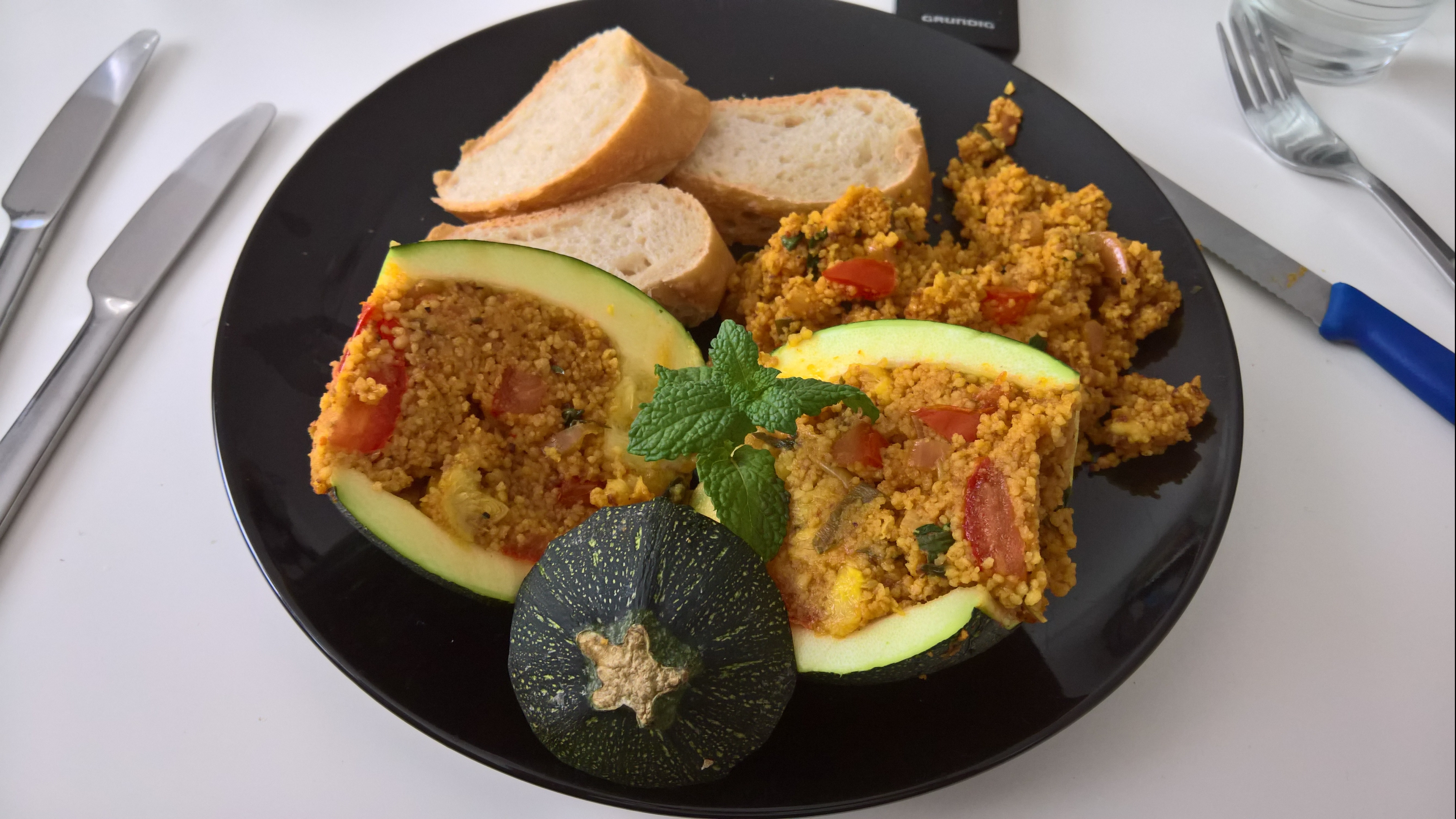
Start by preparing gutting the zucchini and preparing the couscous. From there you make the couscous salad, which you’ll use to fill the zucchini before baking them. The couscous salad will not all fit in the zucchini, which means you’ll have plenty left over for garnish, as a side dish. After baking the zucchini, I like to garnish them with some fresh mint still on the branch. It looks really nice when you serve it this way.

WP_20170611_18_20_18_Pro

4 round zucchini

hollowed out (save the innards for the filling) 

For the couscous:

  • 230g couscous
  • 300ml water or broth boiling.
  • 1Tbsp butter or olive oil
  • Salt to taste 

For the couscous salad / filling:

  • Innards from the zucchini
  • 1 mid-sized tomato
  • 1 stalk green onion
  • 1 red onion
  • 4 Tbsp olive oil
  • 4 Tbsp tomato paste
  • 4Tbsp lemon juice
  • 1 large handful of mint leaves
  • 1 large handful of fresh, chopped cilantro
  • 1 large handful fresh, chopped parsley
  • 1 Tbsp Tajine
  • 1 Tbsp garlic powder
  • 1 Tbsp Turmeric
  • 1 tsp salt
  • 1 tsp black-white pepper
  • Optional: 1 large handful of lemon-basil

Directions

  1. Prepare the zucchini: chop off the top of the zucchini and remove the interior vegetable matter with a spoon. Make sure to leave enough thickness to support the filling. Basically, you’re removing the seeds and surrounding matter. You should notice a difference in the consistency of the material you remove from the material you leave, with the outer walls being denser. To be sure, start in the middle and work your way down and outward. Save the material you remove for the couscous filling.
  2. Preheat the oven to 170°C (150°C convection)
  3. Prepare the couscous: cook the couscous with a tablespoon of oil or butter and a little salt on high heat in a medium-sized pot, stirring often (this roasting causes the couscous to open up and really soak up the liquid). After a few minutes (when you can smell the couscous roasting), shut off the stove and remove the pot from the hot stovetop. Add boiling broth/water. Cover and let steep for 8 to 10 minutes. After the time is up, use a fork to loosen the couscous up and remove any clumps. 
  4. In a large skillet over medium heat, add 3 Tablespoons of olive oil. Add the tomato paste and mix it with the oil. Add the onion and green onion. Cook briefly, without allowing the onions to caramelize. Add the zucchini innards and cook for a few minutes. Once the zucchini is softened, add the lemon lemon juice, mint, cilantro, parsley, and any other seasonings (salt, black/white pepper, lemon-basil, chili, garlic, tajine are all good choices). Cook briefly until the zucchini is done. Add the couscous and cook for a few minutes, stirring often. If it starts to stick to the pan, you can add a little water or oil, but adding too much will make it mushy, so use caution. Once it is well mixed, you are ready to fill the zucchini. 
  5. Fill each hollowed-out zucchini with the couscous salad from the skillet, adding filling until it is level with the cut. Feel free to use a spoon to gently press it into place. Replace the top, and brush with olive oil (some freshly ground salt on the outside is lovely too). Bake for 20-25 minutes 170°C (150°C convection).

wp_20170611_18_22_26_pro.jpg

Numbers 3

Translation:
1) And these were the generations of Aaron and Moses on the day that YHWH spoke to Moses on the mountain of Sinai.
2) And these were the names of the sons of Aaron: The firstborn was Nadab, then Abihu, Eleazar, and Ithamar.
3) These were the names of the sons of Aaron, the anointed priests who filled their hand in the priestly service.
4) But Nadab and Abihu died in front of YHWH when they brought foreign fire before YHWH in the desert of Sinai and they did not have any sons. So Eleazar and Ithamar served as priests before Aaron their father.
5) And YHWH spoke to Moses, saying:
6) “Bring the tribe of Levi and place him in front of Aaron the priest so that they serve him.
7) And they will guard his stewardship and the stewardship of the whole community before the tent of meeting to undertake the undertaking of the Mishkan.
8) And they will guard all of the equipment of the tent of meeting and the stewardship of the sons of Israel to undertake the undertaking of the Mishkan.
9) So you will give the Levites to Aaron and to his sons. They will be given as gifts to him from among the sons of Israel.
10) And Aaron and his sons you will set and they will guard their office of priesthood and a foreigner who approaches will die.”
11) And YHWH spoke to Moses, saying:
12) “And I, behold, I have taken the Levites from the midst of the sons of Israel instead of the firstborn, the first birth of the womb from the sons of Israel and the Levites shall belong to me.
13) Yes, for me is every firstborn. In the day that I struck all of the firstborn in the land of Egypt I sanctified for myself ever firstborn in Israel, from the human even unto the beast. They will belong to me! I am YHWH!”
14) And YHWH spoke to Moses in the desert of Sinai, saying:
15) “Gather the sons of Levi according to the house of their father, according to their tribes. Every male from one month of age and older you shall gather.”
16) And Moses gathered them before YHWH just as YHWH had commanded him.
17) And these were the sons of Levi in their names: Gershon and Qehat and Merari.
18) And these were the names of the sons of Gershon, according to their tribes: Libni and Shimi.
19) And the sons of Qehat according to their tribes were Amram and Yizhar, Chebron, and Uziel.
20) And the sons of Merari according to their tribes were Machli and Mushi. These are they, the tribes of the Levites according to the house of their fathers.
21) Belonging to Gershon was the tribe of the Libnites and the tribe of the Shimites. These are they, the tribes of the Gershonites.
22) Their drafting in number – of all males from one month old and older – their drafting was 7,500.
23) And the tribes of the Gershonites camped following the Mishkan to the west.
24) And the prince of the house of the father of the Gershonites was Elyasaph ben Lael.
25) And the service of the sons of Gershon in the tent of meeting was the Mishkan and the tent, the fabrics, and the curtain of the door of the tent of meeting,
26) And the curtain of the courtyard and the fabric of the door of the courtyard that were upon the Mishkan and upon the surroundings of the altar and the tent seams and the whole of its work.
27) Belonging to Qehat was the tribe of the Amramites and the tribe of the Yizharites and the tribe of Chebronites and the tribe of the Ozielites. These are they, the tribes of the Qehatites.
28) In number, every male from one month and over: 8,600 stewards of the service of the Holy.
29) The tribes of the sons of Qehat camped on the south side of the Mishkan.
30) And the prince of the house of the father of the tribes of the Qehatites was Elizaphar ben Uziel.
31) Their stewardship was the ark and the table and the menorah and the altar and all of the equipment of the holy that served in them and the curtain and its whole service.
32) And the prince of princes of the Levites was Eleazar ben Aaron, the priest; the draft of the stewards of the stewardship of the holy.
33) Belonging to Merari was the tribe of the Machalites and the tribe of the Mushites. These are they, the tribes of the Merarites.
34) And their draft in number – every male from one month old and older – was 6,200.
35) And the prince of the house of the father of the tribes of Merari was Zuriel ben Abichayil. They camped on the northern side of the Mishkan.
36) And the draft of the stewardship of the sons of Merari was the boards of the Mishkan and the braces and the pillars and the tub and all the equipment and its whole service.
37) And the pillars surrounding the courtyard and their tubs and their tent posts and their tent seams.
38) And they camped before the Mishkan on the east before the tent of meeting from the rising of the sun. Moses and Aaron and his sons guarded the stewardship of the holy place in order to guard the sons of Israel And the approaching foreigner would die.
39) All of those drafted of the Levites whom Moses [and Aaron] drafted before YHWH according to their tribes – every male from the age of one month and older – were 22,000.
40) And YHWH spoke to Moses: “draft every firstborn male from the sons of Israel from the age of one month and over and make a counting of their names.
41) And you shall take the Levites for me (I am YHWH!) instead of every firstborn among the sons of Israel and the livestock of the Levites instead of every firstborn among the livestock of the sons of Israel.”
42) So Moses drafted every firstborn among the sons of Israel just as YHWH had commanded him.
43) And it was so: every firstborn male, in the number of the names from one-month olds and older according to their drafting: 22,273.
44) And YHWH spoke to Moses, saying:
45) “Take the Levites instead of every firstborn among the sons of Israel and the livestock of the Levites instead of their livestock. The Levites will belong to me. I am YHWH!
46) And with those who are the ransom of the 273, the excess upon the Levites from the number of the sons of Israel,
47) You shall take five five shekels for their skulls; according to the shekel of the holy you will take. The shekel is twenty gerah.
48) Then you will take the silver to Aaron and to his sons as the ransom of the excesses among them.”
49) So Moses took the silver of the ransom from the excesses of the ransoms of the Levites.
50) From among the firstborn of the sons of Israel he took the silver: 1,365 shekels according to the shekel of the holy.
51) And Moses gave the silver of the ransoms to Aaron and to his sons before YHWH just as YHWH had commanded Moses.

Text Critical Notes:
V. 3: “Filled” is singular in the Hebrew, but must be emended to read in the plural as in LXX and the Peshitta.
V. 4: “Before YHWH” is missing in one Hebrew manuscript, Sam, and the Vulgate.
V. 9: LXX and Sam read “to me” instead of “to him”. Sam. and the Peshitta read “from the midst of the sons of Israel” instead of “from with the sons of Israel.”
V. 10: after “set”, LXX adds “over the tent of meeting”.
V. 16: LXX adds “and Aaron” after Moses.
V. 16–17: The verb opening v. 17 in MT is presumably a corruption of the divine name YHWH. The translation here reflects Samaritanus.
V. 39: “and Aaron” should be deleted, as in some manuscripts, Sam, and the Peshitta. In MT the name is marked by supralinear points, suggesting that the Masoretes may have been suspicious of this name here.

Numbers 2

Translation:
1) And YHWH spoke to Moses and to Aaron, saying,
2) “Among the sons of Israel everyone shall camp according to his group by the banner of the house of his fathers. They will camp surrounding the tent of meeting.
3) Those camping in east will be under the insignia of Judah according to his armies and the prince of the sons of Judah will be Nachshon ben Aminadab.
4) His army and their posts are 74,600.
5) And those camping with him will be the tribe of Issachar. The prince of the sons of Issachar is Nethanel ben Zoar.
6) And his army and his posts are 54,400.
7) The tribe of Zebulon: The prince of the sons of Zebulon is Eliab ben Chelon.
8) And his army and his posts are 57,400.
9) All of the posts of the camp of Judah are 186,400, according to their armies. They will be the first to break camp.
10) The insignia of the camp of Reuben will be in the south according to his armies. And the prince of the sons of Reuben is Elizor ben Shedaiur.
11) And his army and his posts are 46,500.
12) And those camping with him will be the tribe of Simeon. And the prince of the sons of Simeon is Shelumiel ben Zuri-Shaddai.
13) And his army and his posts are 59,600.
14) And the tribe of Gad. And the prince of the sons of Gad is Elisaph ben Ruel.
15) And his army and his posts are 45,650.
16) All of the posts of the camp and Reuben are 151,450 according to their armies. They will be the second to break camp.
17) The camp of the Levites in the middle of the camps will disassemble the tent of meeting, just as they camp, so shall they break camp, each with his hand upon their insignia.
18) The insignia of the camp of Ephraim according to their armies will be in the west. And the prince of the sons of Ephraim is Elishama ben Ammidhud.
19) And his army and their positions are 40,500.
20) And with him will be the tribe of Manasseh. And the prince of the sons of Manasseh is Gamliel ben Pedahzur.
21) And his army and their positions are 32,200.
22) And the tribe of Benjamin. And the prince of the sons of Benjamin is Abidan ben Gidoni.
23) And his army and their positions are 35,400.
24) All of the posts of the camp of Ephraim are 108,100 according to their armies. They were the third to break camp.
25) The insignia of the camp of Dan will be to the north according to their armies. And the prince of the sons of Dan is Achiezer ben Ammishaddai.
26) And his army and their posts are 62,700.
27) And those camping with him are the tribe of Asher. And the prince of the sons of Asher is Pagiel ben Ochran.
28) And his army and their posts are 41,500.
29) And the tribe of Naphtali. And the prince of the sons of Naphtali is Achira ben Enan.
30) And his army and their posts are 53,400.
31) All of the posts of the camp of Dan are 157,600. To the west they broke camp according to their insignia.”
32) These are those who were drafted of the sons of Israel according to the house of their fathers. All of those who were drafted of the camps according to their armies are 603,550.
33) But the Levites were not drafted in the midst of the sons of Israel, just as YHWH commanded Moses.
34) And the sons of Israel did just as YHWH commanded Moses. Thus they camped according to their posts and thus they broke camp each according to his tribe, according to the house of his fathers.

Text Critical Notes:
V. 2: “his group” is plural in Samaritanus.
V. 4: Samaritanus reads “its posts”. Sam. and L. agree in verses 6, 8, 11, 13, etc.
V. 7: Some Masoretic manuscripts, Sam. and the Peshitta add the copula at the opening of the verse, also in verses 14, 22, and 29.
V. 20: The opening may originally have read “And camping with him…” as in the other cases. Cf. LXX.
V. 31: BHS suggests reading “positions” as “armies,” as in e.g., v. 24. As no textual evidence for this change has been cited, any such corruption must have occurred very early in the transmission of the text in order to have become ubiquitous in the traditions.

Numbers 1

Translation:
1) YHWH spoke to Moses in the desert of Sinai in the tent of meeting on the first of the second month in the second year of their exiting the land of Egypt, saying
2) “Count the heads of the whole assembly of the sons of Israel according to their tribes and their fathers’ houses, according to the number of names, every male according to their heads [lit. “their skulls”],
3) From every one twenty years old or older, everyone coming out to fight in Israel, you should muster them for their fighting, you and Aaron.
4) Each will be with you, each for his tribe. Each shall be the head of the house of his fathers.
5) And these will be the names of the men who will stand with you: For Reuben: Elizur ben Shedeur;
6) For Simeon: Shelumiel ben Zurishadai;
7) For Judah: Nachshon ben Amminadab;
8) For Issachar: Nathanel ben Zoar;
9) For Zebulon: Elion ben Chelon;
10) For the sons of Joseph, for Ephraim: Elishama ben Ammihud; for Manasseh: Gamliel ben Pedazur;
11) For Benjamin: Abidan ben Gideon;
12) For Dan: Achiezer ben Ammishadai;
13) For Asher: Pagiel ben Ochran;
14) For Gad: Elyasaph ben Deuel;
15) For Naphtali: Achira ben Enan.
16) These are those called from the assembly, men of the tribes of their fathers; heads of the thousands of Israel are they.”
17) So Moses and Aaron took these men, who had been called by name.
18) And the whole assembly they called together on the first of the month of the second year. And they were registered in the list of generations according to the tribes of the house of their fathers, according to the number of names from those twenty years old or older according to skulls,
19) Just as YHWH commanded Moses. And he assembled them in the desert of Sinai.
20) And these were the sons of Reuben, Israel’s firstborn, their generations according to their tribes, according to the house of their fathers, according to the number of names every male according to their heads [lit. “their skulls”] twenty years old or older, everyone who came out to fight.
21) Their assembly of the tribe of Reuben: 46500
22) Belonging to the sons of Simeon, their generations according to their tribes, according to the house of their fathers, according to the number of names, according to their skulls, every male twenty years old or older, everyone who came out to fight.
23) Their assembly of the tribe of Simeon: 59300
24) Belonging to the sons of Gad, their generations according to their tribes, according to the house of their fathers, according to the number of names, twenty years old or older, everyone who came out to fight.
25) Their assembly of the tribe of Gad: 45650
26) Belonging to the sons of Judah, their generations according to their tribes, according to the house of their fathers, according to the number of names, according to their skulls, every male twenty years old or older, everyone who came out to fight.
27) Their assembly of the tribe of Judah: 74600
28) Belonging to the sons of Issachar, their generations according to their tribes, according to the house of their fathers, according to the number of names, according to their skulls, every male twenty years old or older, everyone who came out to fight.
29) Their assembly of the tribe of Issachar: 54400
30) Belonging to the sons of Zebulon, their generations according to their tribes, according to the house of their fathers, according to the number of names, according to their skulls, every male twenty years old or older, everyone who came out to fight.
31) Their assembly of the tribe of Issachar: 57400
32) Belonging to the sons of Joseph, belonging to the sons of Ephraim, their generations according to their tribes, according to the house of their fathers, according to the number of names, according to their skulls, every male twenty years old or older, everyone who came out to fight.
33) Their assembly of the tribe of Ephraim: 40500
34) Belonging to the sons of Manasseh, their generations according to their tribes, according to the house of their fathers, according to the number of names, according to their skulls, every male twenty years old or older, everyone who came out to fight.
35) Their assembly of the tribe of Manasseh: 32200
36) Belonging to the sons of Benjamin, their generations according to their tribes, according to the house of their fathers, according to the number of names, according to their skulls, every male twenty years old or older, everyone who came out to fight.
37) Their assembly of the tribe of Benjamin: 354000
38) Belonging to the sons of Dan, their generations according to their tribes, according to the house of their fathers, according to the number of names, according to their skulls, every male twenty years old or older, everyone who came out to fight.
39) Their assembly of the tribe of Dan: 62700
40) Belonging to the sons of Asher, their generations according to their tribes, according to the house of their fathers, according to the number of names, according to their skulls, every male twenty years old or older, everyone who came out to fight.
41) Their assembly of the tribe of Asher: 41500
42) Belonging to the sons of Naphtali, their generations according to their tribes, according to the house of their fathers, according to the number of names, according to their skulls, every male twenty years old or older, everyone who came out to fight.
43) Their assembly of the tribe of Naphtali: 56400
44) These are those assembled, who Moses and Aaron assembled. And the princes of Israel were twelve men, one man for each tribe. Each tribe belonged to the house of his fathers.
45) The whole of the assembly of the sons of Israel for their battling, from twenty years and older, all who came out to fight in Israel
46) And all those who had been assembled were 603550.
47) But the Levites were not assembled according to the tribe of their fathers in their midst.
48) And YHWH spoke to Moses, saying,
49) “Indeed, you should not assemble the tribe of Levi and – their heads – you should not count them in the midst of Israel.
50) You should count the Levites before the dwelling of the community and before all the instruments and before all that belongs to it [i.e., the dwelling]. And they will carry the dwelling and all of the instruments and they will service them. Around the dwelling they will bivouac.
51) And when they break camp, the Levites will take down the dwelling. When they make camp, the Levites will set up the dwelling. But anyone not permitted who approaches will die.
52) The sons of Israel will camp, one was at the camping place, and the other at his emblem for their battle assembly.
53) But the Levites shall camp around the dwelling of the community so that the anger of YHWH will not be against the community of the sons of Israel.” So the Levites undertook guardianship of the dwelling of the community.
54) So the sons of Israel did just as YHWH commanded Moses and Aaron. Thus they did.

Text Critical Information:
V. 2: “whole” is missing in the Samaritan Pentateuch.
V. 3: “You” in the Masoretic text is plural, but the Samaritan and Syriac versions read the singular.
V. 18: Text emended to include “the second year” as in LXX.
V. 20: Text emended to match v. 1, the Samaritan text, and the Peshitta.
V. 22: The text has been abbreviated to match the best witnesses.
V. 42: The preposition translated as “belonging to” is missing in Codex Leningradensis, but attested in the best witnesses.
V. 44: Emend to read with LXX and the Samaritan text.
V. 45: Text Emended to follow LXX and the Samaritan text.
V. 54: LXX adds “and Aaron,” which has been used here.

Brief Commentary on the Text:
The condition of the Masoretic Text makes a pretty good impression in Numbers 1. While I have not commented on every text critical matter published in the ciritical edition, the most important have been reflected here. The translation does not read very smoothly. The Hebrew syntax is quite lengthy for a narrative text and it is somewhat unclear at first glance why so many designations for the people who were to be counted were used. Curious is also the use of “skulls” in the categorization of those who are to be counted. This text can generally be regarded as a unity; there is nothing on the surface that necessitates or mandates a division of the text into multiple sources in this verse. On the surface, the immediate priority of the Levites over the rest of the tribes jumps out. Since the text ends with the handling of the Levites and does not even really count them among the other “sons of Israel”, one recognizes a strong emphasis on that group. This emphasis will presumably be expounded in other texts in the book of Numbers.

Coming soon to an Internet near you…

In keeping with the research project in Essen that I am working on, I have decided that I will translate the book of Numbers here on my blog. My translation will be based on the Hebrew text with some text-critical notes about how the text probably read before corruptions and other changes crept in. I hope that anyone reading this will also feel free to comment on or suggest changes that my be necessary. However, I have not yet decided if I am going to post the chapters in order or not. We’ll see how I ultimately decide to put this translation into practice. Hopefully this will turn into a fruitful project. More soon!

This Blog has been censored.

Censored

The Underbelly of Pentateuchal Research

So, lots of people ask me what it is that I actually do all the time. I figured this would be a good enough venue to write about that a bit and provide some concrete examples of what is up.

My life currently consists of the following elements: 1) limited social engagements (to my friends in Erlangen: “Servus!”); 2) researching the redactional history of the Pentateuch; 3) compiling a research project covering the text history of the dodekapropheton; 4) studying for my PhD oral exams (rapidly approaching on May 30, 2011); and 5) watching Scrubs and a variety of films on DVD.

Most people can probably associate something with numbers 1, 4 and 5, but perhaps not as much with 2 and 3, so I’ll offer a little bit more about them.

To 2): This is part of a research project that I am working on with the University of Essen under the tutelage of Professor Dr. Aaron Schart in combination with the Universities of Bochum (Professor Dr. Christian Frevel) and Dortmund (Professor Dr. Thomas Pola). What are we researching? The redaction history of the Pentateuch, most especially as it relates to the book of Numbers. Now that sentence probably requires a little explanation. I don’t know who’s reading this, but I’ll assume that not everyone is familiar with these terms. What is the Pentateuch? Rather than send you to Wikipedia to look it up, I’ll tell you that the term “Pentateuch” refers to the first five books of the Bible (whether in the Jewish or Christian canon), commonly called the Torah in the Jewish canon and traditionally associated with Moses, i.e. until about the 18th century most, but certainly not all, people generally accepted the precept that Moses wrote these five books. Even in antiquity Jewish scholars began to have some problems with this notion, as Deuteronomy 34 describes Moses’ death, and someone writing about his or her own death and burial is, as far as I know, still unknown from any historical personage. At any rate, the name Pentateuch comes from the combination of two Greek words, πεντα and τευχος, meaning “five” and “book” respectively. Thus, the namely Pentateuch means “Fiver-Book” because of its division into five parts, commonly known in English by the names Genesis, Exodus, Leviticus, Numbers, and Deuteronomy.

Regarding the Pentateuch, we are focusing on redaction history. What that references is the way that the Pentateuch developed. Contrary to the opinion of some, the evidence strongly suggests that the Bible did not fall from the sky in its current form, but grew over a process of centuries into the amazing example of theological discourse spanning hundreds (if not thousands) of years that we find before us today. In the late pre-Modern period, people – not all of them theologians – began to notice tensions within the text of the Pentateuch which led them to postulate a variety of sources and redactional levels in the text. By redactional material, we generally refer to portions of the text added by an editor and not coming from source material. A general concensus began to develop over the course of the 19th and early 20th centuries about what material came from which source, how the sources were chronologically related to one another, when they were added together, and what material came from the person(s) responsible for that textual editing. During the later twentieth century, especially in the last third, this consensus collapsed, especially in the continental European context. Now there are a variety of theories running the gamut from total atomization of the text (i.e. it is next to impossible to discern how many people took part in the writing and composing over how many centuries) to the text coming largely from a single author or a few authors, composing at a very late period. This research project hopes to tackle the problem in a new way, setting the book of Numbers as our starting point.

Why the book of Numbers? Well, the problem with Numbers is that it doesn’t really fit well into anybody’s theory. Numbers is a disparate work with material from a variety of genres and sometimes really barely seems to make sense (though loads of these problems have been removed from translations into English). This problem has led some to conclude that Numbers became kind of a catch all for the rest of the material that people wanted to put into the Torah and didn’t know where else to do it. I disagree with this opinion because I find it largely a cop-out and a devaluation of the traditions in the book. What I am not sure of is what theory better explains the circumstances, and thus, it’s appropriate that I take part in a research project researching this matter. If you take one thing from this blog entry though, it should be the impetus to sit down and read Numbers; there is some crazy stuff going on in that book.

To 3): What in the world is a “Dodekapropheton”? Well, we only have one of them, at least as far as I have ever discovered. It refers to the book of the Twelve Prophets, also known as the Twelve Minor Prophets. In the Christian canon they are the last books of the Old Testament, whereas in the Jewish canon, they conclude the prophetic materials and precede the Writings. These poor prophets are not called minor because they lack import – Amos and Hosea are my personal favorites – but rather because the books are vastly shorter than those of some of their prophetic colleagues, namely Isaiah, Jeremiah, and Ezekiel. If you have any background in the Christian or Jewish tradition, you have most likely heard of these three. (At least growing up in the United States, you should know the name Isaiah from Isaiah Thomas, Jeremiah the bullfrog, and Ezekiel from Weird Al) The other prophets are the ones that many, or most, have never heard of. Like if I were to tell you that there is a prophet in the Bible named Habakkuk, you probably wouldn’t believe me, but you know what, he’s in there, just like Obadiah, Zephaniah, Nahum, and some other fun names. Look it up.

The Twelve Minor Prophets have been considered to be a single book since antiquity. Evidence from Qumran suggests that, at the latest, the Twelve were regarded as one book in the century before the Common Era. The name Dodekapropheton, like Pentateuch, comes from two Greek words: δωδεκα, which of course all of my D&D friends will recognize as meaning “twelve” (as in dodekahedron, as in being shaped like a 12-sided die [oh yeah, now I finally understand that Weezer lyric]) and, well, I imagine you can figure out the rest. It means Prophet (or better Prophet-Book).

Rather than focus on the redaction history of the Book of the Twelve, this project focuses on the textual history. As I mentioned before, the Bible didn’t fall from the sky in its current form – and even if it had, we have the problem that tons of people starting copying and translating it so that no two manuscripts are identical. That presents a problem, namely what is “The” Bible. This project tries to get behind some of that and see who is copying what, when, and where. Where there are differences in the text – and there are differences in the text, even though more often than not, they are minor – these differences should be explained. Was it a scribal error? Was there another version of the text being copied or translated? Did the scribe copying or translating change the text? Why? Can specific linguistic or ideological profiles be established for the people doing this work? This is the kind of stuff that I do.

So, that’s a little bit of behind the scenes. I hope to write more about the specifics of my work in the future and bring in some of the academic dialogue running in the background. Maybe you’ll find it as interesting as I do.


Made the big move…

After four and a half years in Erlangen, Germany working in the Institute for Old Testament there and finishing my dissertation, I have moved to Wuppertal, Germany. Here, I’ll be working for Prof. Kreuzer in Wuppertal and for Prof. Schart in Essen, working on research projects and composing proposals for stipends to pay for the expansions of these research projects.

I’m pretty excited about the new opportunities here, although I’m a little disappointed that I haven’t finished my PhD yet. Due to circumstances beyond my control, I had to move here before everything in Erlangen was finalized, meaning that I get to pay the 120 Euro to go back in April or May to take my oral exams. No need to complain about it, I just wish that I had been able to finish that off and start off here with a clean slate.

At any rate, I have spent the last week getting to know the material for the research that we are undertaking here, as well as aquainting myself with the environs. Both of the professors here are really interested in supporting me thus far and have really gone out of their ways to make sure that everything gets moving. That makes the research that much more appealing, but I’m really excited about it simply because the subjects are huge, detailed, and currently hot spots in the world of academia.

At the present, I have been doing some correcting work and assisting in the composition of the indices for Explanatory Volume of LXX.D (Septuaginta Deutsch), spending my afternoons looking up the various names of the Qumran texts and the various papyri that LXX.D references in its discusions of the various attestations of Greek forms or their Hebrew equivalents. Since the new volume has more than 3000 pages, it’s pretty tedious work, but I think that I have done a good job and will hopefully have helped scholars look up the materials that they seek.

On the other hand, I have been doing some research to get ready for a conference called “Torah in the Book of Numbers” that will be taking place on April 12-13, 2011 in Bochum, Germany. I’m trying to catch up on the newest and the classical positions on the Book of Numbers and the development of the Pentateuch/Torah. Since the people coming to present at this conference are great international scholars, I’m really looking forward to it. The singular problem is that there is way too much material to cover by then, that I could never ever possibly read it all. Write now I am working my way through the materials of Joel S. Baden, whose work I don’t know at all. He has some interesting positions, and I’m really looking forward to how he develops his thesis.

Eventually I hope to get some more research done on my next planned project: the Dodekapropheton (The Twelve Minor Prophets). However, if I start to love all of the research in the Pentateuch, I may find it hard to get back out of it. We’ll just have to see how it develops…

  • Welcome to my blog!

    I hope you find the material here both entertaining and informative. Or at least one of those two. Or neither. Welcome to my blog!
  • Enter your email address to subscribe to this blog and receive notifications of new posts by email.

  • Follow Jonathan Robker: Exegete, Critic, Cook on WordPress.com
  • Archive

  • Twitter Timeline