Translation of 1 Kings 1:22-27 (MT)

22. But, dude! Still she was speaking with the king, and Nathan the prophet entered.

23. And they declared to the king, saying, “dude! Nathan the prophet.” And he entered before the king and prostrated to the king, upon his nose, to the ground.

24. And Nathan said, “my lord, o king, you, you have said, ‘Adonijahu will reign after me, and he will sit upon my throne’?!

25. “For he went down today and sacrificed steer and fattened calves and sheep for the many, and he called to all of the king’s sons and to the military officers and to Abiathar the priest. And, dude! They are eating and drinking before him, and they said, ‘long live Adonijahu, the king!’

26. “But to me (I am your servant) and to Zadok the priest and to Benaiahu ben Jehoiada and to Solomon, your servant, he did not call.

27. “If [this is] from my lord, the king, [then] let this thing be done. But you have not let your servants know who should sit upon the throne of my lord, the king, after him.”

Commentary on the Text

From a narrative perspective, v. 22 ends Bathsheba’s speech to the king without mentioning that she is done talking. In fact, the verse’s opening suggests that the prophet interrupts her speech, fulfilling precisely that which he proposed (v. 14). The mention of Nathan’s office places him on a distinct footing when contrasted with Bathsheba, whose identity the text does not further elucidate in v. 15, as is done here with Nathan.

The distinction between these two characters becomes yet more marked in v. 23. Three matters seem to elevate Nathan above Bathsheba in this verse. First, Nathan is announced by some unnamed group of people, presumably a court or something. Nothing similar is reported for Bathsheba. Second, his title is again reiterated in the announcement of his arrival, again in contradistinction to Bathsheba. Third, there is strong emphasis placed on his obeisance to the king. It reiterates that he not only prostrated, as Bathsheba had while kneeling, but even put his nose to the ground. The prophet appears to be laying it on thick, and this verse certainly lends him a more political air than that afforded the (hopefully) more personally relevant Bathsheba.

However, vis-à-vis the king, Nathan takes a more forward approach than Bathsheba had. Whereas the king inquires what Bathsheba wants (v. 16), Nathan simply interjects his issue. I presume that this implies social bias against Bathsheba in the text: the woman should only speak when addressed and it merits no comment when her speech is interrupted first by the court and then by the announced guest. David has thus far not reacted to her concern, whether legitimate or not. Perhaps the text is making a statement about Nathan’s power-relation to the king as well. Nathan more or less exclaims what the king has previously said. It could be understood as a question, but the Hebrew by no means makes it explicit. For this reason, I have chosen to translate it here as a surprised interjection. He asks not what the king has said; he states that the king said such while simultaneously expressing his surprise and dissatisfaction. It’s an effective rhetorical strategy for the subsequent speech: the prophet lists some facts that led him to the conclusion he states in his speech’s opening. At the same time, Nathan’s manner of addressing the king here could be understood as reinforcing the narrator’s intimation from v. 4 that the king has become and is impotent.

Verse 25 presents Nathan’s nuanced version of the same information Bathsheba recounted in v. 19. The language is quite similar, but the distinctions are perhaps noteworthy in that they make the scenario appear somewhat more dangerous for David than Bathsheba. Nathan’s versions moves the military to the second position in the list of persons affiliated with Adonijahu and expands their number from merely “Joab” to “the officers.” Only then does he add “the priest Abiathar.” Finally, he notes that they are banqueting with Adonijahu and have proclaimed him king. While Bathsheba suggests that Adonijahu is already starting to rule without the king’s knowledge (v. 18), she then notes that this will only have real consequences once the king has died (v. 21). Nathan intimates that these people already regard Adonijahu as king. That puts, certainly implicitly at least, the current occupant of the throne in precarious circumstances.

Again in v. 26 Nathan provides details more in line with his station than those emphasized by Bathsheba in vv. 19 and 21. He mentions, while reiterating his loyalty to the king, that he and Zadok the priest and one particular officer (presumably loyal and certainly without Joab’s baggage) were not invited. And this, in addition to Solomon. Bathsheba, understandably and in line with her personal relationship to the king, only noted the lack of an invitation for her son.

Nathan’s speech concludes with a few excellent rhetorical features. His first phrase in this verse shows him now, for this first time in this passage, deferent to the king. That makes his position perhaps more appealing to the sitting monarch. And rather than conclude that the king must demonstrate his plan for succession to “all Israel,” as Bathsheba suggests (v. 20), Nathan states that the king must only inform his “servants” who will succeed him. Allowing for an appropriate amount of suspicion, what the conclusion of this speech really demands is that the king tell Nathan and Solomon, the two people who are described as the king’s servants in this speech, who should reign after him and sit on his throne. This anticipates the answer they hope the king will provide, perhaps again implying the king’s impotence. Again, it should be noted here that the narrator has nowhere suggested this is the divine will that the prophet is espousing. Yet, tellingly, the king does almost exactly what the prophet demands, showing that Nathan’s plan worked. And the king suspects nothing.

Translation of 1 Kings 1:15-21 (MT)

15. And Bathsheaba went to the king, to the room. And the king was very old. And Abishag the Shunamite was serving the king.

16. And Bathsheba knelt and prostrated to the king. And the king said, “What do you require?”

17. And she said to him, “my lord, you swore by Yhwh, your God, to your maidservant, ‘yes, Solomon, your son, will reign after me and sit on my throne.’

18. “But now, dude! Adonijah rules! And now my lord the king does not know it!

19. “And he has sacrificed steer and fattened calves and sheep for the many and, he called to all of the king’s sons and to Abiathar the priest and to Joab, the army commander; but to your servant Solomon he did not call.

20. “And you, my lord, the king, the eyes of all Israel are upon you to explain to them who will sit upon the throne of my lord the king after him.

21. “And it will be: when my lord, the king, sleeps with his ancestors, I and my son Solomon will be interlopers.”

Comments on the Text

Verse 15 initially and promptly continues the preceding narrative, with Bathsheba apparently undertaking Nathan’s proposed plan. At least there is no reason at the outset to doubt that this is what she is doing. Curiously, the first phrase contains two objectives of Bathsheba’s travel: to the king (without calling him David) and to the chamber, though not specifically the king’s chamber. The appended definite article, i.e., “the chamber,” suggests that the reader should know what chamber this is, though none has been mentioned in Kings thus far. (The last appearance of this term was in 2 Sam 13:10, a poignant text that describes Tamar innocently going to visit her brother Amnon who is about to rape her. Should this imply untoward activity in the verse at hand?) After this initial continuation of the preceding, the text takes a turn back to the chapter’s opening, mentioning both David’s advanced age and young woman Abishag, who is serving him. This is the last time that Abishag appears in the Bible other than in a conversation between other characters. Her presence here makes me wonder what purpose she is supposed to serve. Should she be a witness to this event? Perhaps an oblique source for the story as told here? The narrator never intimates these details.

Bathsheba casts herself down before the unnamed king in verse 16. The anonymous king responds to this act by asking what she requires. The Hebrew literally says only “what [is] for you.”

The beginning of Bathsheba’s speech to the king in v. 17 picks up the language from v. 13, having her fulfill precisely that which Nathan commanded her. Again, the referenced “swearing” here appears nowhere else in biblical literature.

The continuation, in verse 18, of Bathsheba’s speech to the king picks up Nathan’s language from v. 11b, the opening of the prophet’s speech and proposition to Bathsheba. She is no longer doing what Nathan said, but still borrowing from his language.

The pinnacle of Bathsheba’s speech in v. 19 places the narrator’s words in Bathsheba’s mouth. She now references material about which she should have no knowledge, at least nothing that Nathan mentioned, though the narrator had in vv. 7a, 9, and 10b.

Verse 20 moves the speech beyond the personal level between Bathsheba and the king. She invokes the need for the king to take a public stance in naming his successor. The king’s hand is somewhat forced, in that “the eyes of all Israel” are upon him to see his decision. Bathsheba’s language echoes back to vv. 12 and 17, mentioning both “who will reign” and “the king’s throne.”

The conclusion of Bathsheba’s speech in v. 21 looks back to verse 19, making verse 20 look a little like an interpolation. After mentioning the king’s public announcement of his successor, there should be no need for Bathsheba to fear that she and her son will be regarded as a danger to the new king. Rather, in sum, her son should be the new king. Bathsheba relies on a distinct rhetorical tactic in this verse: now she no longer references some injustice that has been done to her son, rather describes the threat to his life apparently to awaken the king’s fear for the lives of his wife and son.

Translation of 1 Kings 1:11-14 (MT)

11. And Nathan spoke to Bathsheba, Solomon’s mother, saying, “have you not heard that Adonijahu ben Haggith reigns and our lord David does not know it?

12. “And now, come, let me counsel you (with) counsel. And let your life and the life of your son Solomon escape (= save yourself and your son).

13. “Go and come to the king, David, and you will say to him, ‘you, my lord, the king, did you not swear to your maidservant, saying “yes, Solomon, your son, will reign after me, and he will sit on my throne.” So why does Adonijahu reign?’

14. “Dude! You will still be speaking there with the king and I, I will come in after you and will fill your words.”

Comments on the Text

At first glance, v. 11 is overloaded with personal identifiers, particularly since the reader is familiar with all of these characters. The mention of Bathsheba as “Solomon’s mother” and Adonijahu as “son of Haggith” are somewhat superfluous in context. The opening of Nathan’s speech in this verse is only the third time that the name “David” appears in the book. It is the first time that it remains unqualified, bearing neither the title “the king” nor the reference to his soldiers. While from a literary standpoint, this episode clearly continues from the preceding, it is conspicuous that Nathan, and not Solomon, is suddenly Adonijah/u’s alternate as the head of one of the opposing parties.

In verse 12, Nathan’s first command to Bathsheba is not literally to “come,” but rather to “go.” Biblical Hebrew uses this similarly to “come now” or “come on” in contemporary English. In the continuation of his speech, Nathan presumes that Adonijah/u will kill both Bathsheba and Solomon, though such has been intimated at no point thus far in the narrative. He expresses this as an imperative with the verb “escape,” used here as a transitive with the objects “your/your son’s breath/life/soul.” First Nathan expresses why Bathsheba should act, before stating how in the next verse.

Nathan tells Bathsheba what to do in vv. 13-14 and informs her how his plan will develop. She should go to the David, once again, described here as “the king” and tell him of a promise he made to her, to make her son king after him. I initially started to write “remind” instead of “tell” in the previous sentence, but David has never made such a promise–to Bathsheba or anyone else–anywhere in the Bible. This is the first time that it has been expressed that Solomon should succeed David on the throne. Nathan suggests she should mention both that Solomon should reign and that he should sit on David’s throne, essentially a duplication that we find variously in the next chapters of Kings. Again, Nathan refers to Adonijahu, not Adonijah. This whole plan sounds suspicious from the outset. Perhaps the previous identification of Nathan as “the prophet” in vv. 8 and 10 should let the reader imagine that this whole idea stems from God, but the narrator has at no point either explicitly stated such nor obliquely implied it.

Nathan’s instructing Bathsheba concludes with he noting his part in the whole plan: he will come in and confirm what Bathsheba has said. That being said, he does not enumerate specifically what he will confirm, other than Bathsheba’s words generally. That is, which part of all of this will he affirm: Adonijahu’s attempting to reign (a fact that the narrator has imparted to the reader) or “the king’s” presumed promise to Bathsheba (to which the narrator remains silent)? This conclusion to the speech again raises eyebrows and leaves the reader somewhat suspicious.

Translation of 1 Kgs 1:5-10 (MT)

5. And Andonijah ben Haggith raised himself, saying, “I, I will be king.” And he made for himself chariotry and horses and fifty men running before him.
6. And his father had not upset him from his days, saying, “to what end did you do thus?” And also he was of very good form. And him she bore after Absalom.
7. And his words were with Joab ben Zeruiah and with Abiathar the priest, and they helped behind [i.e., they supported] Adoniah.
8. And Zadok the priest and Benaiahu ben Jehoiada and Nathan the prophet and Shimei and Rei and the warriors who belonged to David, they were not with Adoniahu.
9. And Adoniahu sacrificed sheep and cattle and fattened calves with [= “at”?] the stone of Zoheleth [“Slithering Stone”] that was by the Rogel well. And he called all his brothers–the sons of the king–and to all of the men of Judah–the servants of the king.
10. And Nathan the prophet and Benaiahu and the warriors and Solomon, his brother, he did not call.

Comments on the Text

Verse five has, at first glance, nothing to do with the preceding material. The text reintroduces a character, namely Adoniah, the son of Haggith (and David, who is not named here). The last time he appeared was in a list of David’s sons in 2 Sam 3:4. The same is true of his mother. Adoniah is said to “raise himself,” an unusual reflexive form of a common verb, and proclaim his ascendency to the throne. Both verbal forms used for Adoniah here are unique in the Hebrew Bible. The remainder of the verse serves to cast Adoniah in a suspicious light, in that it strongly echoes the description of Absalom, David’s son. Second Samuel 15:1 reports the beginning of Absalom’s revolt against his father. Though the terms for chariotry and horses differ in these cases, the intention seems to be clear: Adoniah is revolting against his father, just as his brother previously had. So, while the first half of the verse recounts something distinct, the latter half sounds distinctly familiar to anyone who knows the stories of the book of Samuel.

Verse six relates Adoniah to his father, who is not named nor is his office mentioned. The verb “upset” has not appeared in the Hebrew Bible since 2 Sam 19:3, where it describes the king’s (David’s) mourning for his son Absalom (incidentally, it is also the term used for the pain of a woman in childbirth in Gen 3:16, if that matters). That is, the connection here points back to the Absalom story, just as the preceding material. The mention of Adoniah’s appearance might seem unusual initially, but it relates his both the David and Absalom (cf. 1 Sam 16:12, 18; and 2 Sam 14:25). Unusually, the final phrase in this verse returns back to Adoniah’s mother, mentioned in v. 5. At least, the subject is feminine. However, the phrase would suggest that Haggith was also the mother of Absalom, which was not the case according to 2 Sam 3:3-4, which notes that different mothers bore Absalom and Adoniah.

Verse seven turns to Adoniah’s supporters, namely Joab and Abiathar. Both of them play important roles in Samuel. Joab killed the usurper Absalom (2 Sam 18:14), and Abiathar supported David in his quests against Saul and Absalom. Both of these men are mentioned to prepare for the resolutions of their stories in chapter 2 and their supporting Adoniah anticipates what that resolution will be.

The next verse, v. 8, establishes a second group against Adoniah, who now suddenly has a differently spelled name, “Adoniahu.” All of the men mentioned here served David (who is also mentioned here for the first time since v. 1) in some capacity or another. Again, with the exception of Shimei and Rei, the names mentioned anticipate what happens in chapter 2 and the rest of chapter 1. Here it becomes conspicuous that Adoniah/u did not have prophetic support. The formulation is also unclear: did Adoniah/u not seek to work with these men? Or why were they not with him?

The division of the groups continues in vv. 9-10. Verse 9 reports that Adoniahu essentially throws a grill party and invites the important people in the kingdom, particularly the (once again nameless) king’s sons and servants. Should this be understood as Adoniah/u’s attempt to lull them to his side? A note on the locations: En Rogel should apparently be understood as some kind of boundary location between Judah and Benjamin (cf. Jos 15:7 and 18:16); the Slithering Stone does not appear elsewhere in the Bible.

The episode here concludes here by mentioning whom Adoniah/u did not invite to the party. With the exception of Solomon, this repeats data already noted in v. 8 (though now without the priest). Conspicuously, Solomon is described as Adoniah/u’s brother, but obviously was not included among the “sons of the king” in v. 9. Is that a jab at Solomon, perhaps questioning his parentage or offering a different background for him than that reported in 2 Sam 12?

Translation of 1 Kings 1:1-4 (Masoretic Text)

  1. And the King, David, was old. He came in the days. And they covered him with the blankets, but it was never warm for him.
  2. And his servants said to him, “let them seek for my lord, the king, a young woman, a virgin, so that she can stand before the king, and she can be for him an official and lay in your lap and it will be warm for my lord, the king.”
  3. And they sought a beautiful young woman in the whole territory of Israel, and they found Abishag the Shunamite, and they brought her to the king.
  4. And the young woman was beautiful, even greatly so. And she became for the king an official and she served him, but the king did not know her.

Comments on the Text

Two observations merit mention in verse 1. First, syntactically, it appears as if David was added as an afterthought. The subject “the king David” is unwieldy and probably the product of editing. One notes in this vein, that David essentially vanishes from the text after this verse, which consistently refers to “the king” without mentioning a name. Second, the final phrase regarding the king’s inability to be warm appears in the imperfect, suggesting that it should be understood as an iterative. It is not that he is not warm only once; rather, he is never warm.

The woman the king’s servants propose to seek should fulfill two functions: she should serve him as an official (the term is otherwise used for someone like a chancellor in Isa 22:15) and also lay in his lap. That’s an exceptional combination of distinct services, to say the least. Only the latter has to do with verse 1.

The woman they eventually find in verse 3 is said to come from the territory of Shunem, known otherwise in the Bible as a town in the north of Israel and ascribed to the tribe of Issachar. This town may be mentioned in Egyptian correspondence from the Amarna period. Any identification of the site is currently insecure. Interesting here is that the king’s servants seek a woman for him in the north of Israel. If this is about David, who should be from the south, we see perhaps something of an imperialistic tendency, perhaps even an implied overreach, suggested in this action. More importantly: Abishag is found and brought to David. It is never suggested that she came willingly, at best, only passively.

Verse 4 initially focuses on Abishag’s appearance and notes that she is especially attractive. That could only have merit for one of her supposed functions for the king. The text does not even mention her name here, describing her only as “the young woman”; older translations preserve readings like “maid.” The verse continues, noting that she serves the king in some official capacity. Nonetheless, she never speaks in the Bible. Finally, the verse (and this brief passage) conclude with the notice that the king did not know her, i.e., he did not have sex with her. Two (perhaps not entirely mutually exclusive) options bear consideration here. Is the text trying to preserve the dignity of the king or the woman by stating that there was no physical intimacy between them? Or is the text mocking the king, saying he was impotent (in every sense of the word)? This second option is especially poignant, if the text was always about David, who had a somewhat voracious appetite for women (though not as ludicrous as that of his son and successor Solomon).

Translating First Kings 1-15

I wrote the following paragraph in the days before lockdown began in March 2020. Today (10 July 2020) I found a few minutes to look at my blog again and think about the future of what I’m going to be doing here.

As part of a commentary project I am working on, I will be translating the various versions of 1 Kings 1-15 (particularly Hebrew and Greek). These chapters present exegetes with a variety of problems, including its existing in a number of distinct variants. For the sake of access and gaining input, I have decided to put some preliminary translations of these chapters in the various versions online as I finish them. Where possible and desired, I will try to add comments on textual and other diachronic or tradition-historical issues. My request to readers: take a look at them and pose questions about their meaning and content. Also simple stuff like typos and what not. I would appreciate feedback from experts and laypeople alike, so give me your questions and comments.

A General Overview of the Textual History of the Hebrew Bible / Old Testament, pt. 2

What is the Septuagint?

This is a tricky one, but I think a fun one. Sometime in the third century BCE, someone decided that the Hebrew scriptures, at least the texts that ultimately became scripture and some others, should be translated into Greek. The legend goes that they were translated for the library of Alexandria at the behest of the Ptolemaic king of Egypt. He wanted a copy of every book in the world for his library. That, of course, would include the Hebrew scriptures of the Jewish community in Alexandria. For them to be understandable to the contemporary audience, they need to be translated into Greek. Thus, experts would be needed to translate the Hebrew texts into Greek. The legend continues that 70 (actually 72, i.e., six from each of the twelve “tribes of Israel”) men would translate the scriptures. Christian recensions of this legend recount that the 72 men translated for 72 days and – miraculously – all produced an identical Greek translation of the Hebrew text. The number 70 (in Greek) became the name for this translation: the Septuagint. (Cf. the most accurate adjective for all of the major-party candidates for president of the USA in the 2020 election: Septuagenarian.)

Obviously, not every element in this story can be regarded as historical. Additionally, not every element of the story is clearly defined. For example, it seems improbable that the whole of the scriptures was translated at once. It even seems unlikely that the first translation included the whole of the Torah, called “Pentateuch” in Greek, i.e., the first five books of the Bible, traditionally called the books of Moses. So, is there anything in the legend that is believable or trustworthy?

Linguistic analysis of the oldest (reconstructed) translations suggests that Egypt from about the third century BCE seems a likely historical circumstance for the beginning of the translation. However, the process of translating the Hebrew scriptures was ongoing and certainly not undertaken at only one time. It continued for centuries and even included revisions of older translations. It is questionable whether the translation of the Hebrew scriptures was initiated at the monarch’s behest. The historical circumstances permit it, at least. Perhaps it was initiated because of the construction of the library of Alexandria, making the monarch at least indirectly responsible. Alexandria was home to a large Jewish community at the time, so it seems likely that they might have initiated it in accord with the Zeitgeist. Another matter remains unclear: namely what the first translated text was, of what it consisted. That still remains a problem. Likely candidates are Genesis and Deuteronomy. And that brings us to another problem, to what does the term “Septuagint” refer?

The term’s original referent was to the initial translation of the Torah, i.e., the Pentateuch. Over time, the term lost some of its specificity and referred to the Greek translation of the whole of the Hebrew scriptures. Most use the term today to cover basically everything biblical in Greek that isn’t the New Testament. Due to the loss of specificity and clarity, scholars in the field have since begun to distinguish the terms they use. “Septuagint” can still basically refer to anything Greek and biblical that is not the New Testament. When referring to the original translation of a specific text or book, they now prefer the term “Old Greek”. This is necessary since some Greek translations, maybe all of them, have been revised and some, probably all, have been corrupted over the course of their transmission.

The corruption is easy to explain: when people copy texts, errors creep in. Texts are misread. Handwriting becomes illegible and difficult to read and copy. Copyist’s eyes skip over words and lines. Words get copied twice and so on.

More complicated are the revisions of the text. This occurs in limited contexts, on the one hand. That is, some superficial conscientious changes creep in to the text. Several reasons for this are readily recognizable: replacing one word with a more understandable or contemporary word, removing something that is ideological problematic (at least from the translator’s or editor’s perspective), avoiding difficulty in a text, revising towards internal or external consistency within a body of works, and so on. The Old Greek, as far is it has been reconstructed to date, has many such revisions throughout its text. (One should not overstate this, though; taken on a whole probably 98% of the Old Greek’s text reflects a Hebrew text consistent with the Masoretic Text, at least in books that do not have markedly distinct Greek versions like Exodus, Samuel, Kings, and Jeremiah.)

On the other hand, several of these revisions, present even essentially new translations of the Hebrew into Greek. Such broad revisions are historically documented with distinct monikers even from Antiquity. One such larger school of revision was only identified in Modernity. Ironically, it is probably the oldest revision that we now recognize. Some of these revisions occurred within Jewish circles, while others were undertaking by Christians. To the terminology: in general, scholars refer to these larger, distinct revisions as “recensions” and identify most of them with the names of specific individuals with whom they have historically been associated. Here’s a graphic that I made to describe the relationship of these various recensions to the Old Greek, to the Hebrew, and to each other for one of the more complicated cases in the Bible’s textual history: Samuel and Kings.

Overview of the general textual history of Samuel and Kings

This graphic reflects a few different points. The black line along the top represents the development of the Hebrew parent text with the boxes representing distinct phases or versions of that text. The red material all reflects Greek translations or revisions of the Greek text from the first Greek translation of the Hebrew (i.e., “the Old Greek”). The dotted red lines reflect postulated influence or development from one Greek version to another. The distance between the red and black lines represents the proximity of the versions to one another. That is, the closer a red version is to the black line, the more closely it reflects its Hebrew parent text. For example, generally, the Old Greek of Kings seems to be good translation Greek, that is, Greek that is obviously a translation and not a compositional Greek. It generally follows the strictures of good Greek grammar and would have been cogent for native Greek speakers, if somewhat curious in its phrasing and syntax. The kaige elements of Kings are much closer to the Hebrew text and often reflect elements of the Hebrew that are superfluous or even damaging to the Greek. An example will hopefully suffice: Hebrew has two words for the first-person singular pronoun “I”, אנכי and אני. These two terms, one longer than the other by one consonant/syllable, are semantically identical. They bear no distinction on the understanding of a text. However, the kaige translator(s) distinguished between these two terms in Greek, translating the short form with ἐγώ (“I”) and the long form with ἐγώ ειμι (“I am”), even when it was followed by a finite verb and therefore incomprehensible in Greek. (That would be like the difference between “I go” and “I am go” in English; the first makes sense, the second does not.)

But why is all of this in a discussion about the Septuagint? Well, with time, the term “Septuagint” changed from referring to the Greek translation of the Torah (i.e., “the Pentateuch”), to the Greek translation of each book in the Hebrew canon, to basically everything biblical in Greek, but not the New Testament (which is, of course, also in Greek), including all of the different versions and recensions of the Greek text. What is more, these versions were known, at least some of them, in Antiquity and were recognized as distinct. Origen collected and collated different versions in a monumental text-critical project called the “Hexapla”. There, he transmitted no fewer than four Greek versions of the Bible: his version of the “Old Greek” (wherever he had gotten that from) and the recensions of Aquila, Symmachus, and Theodotion. It also included a column with the Hebrew text as well as a column with a transliteration of the Hebrew with Greek letters. In the preface to his translation of Chronicles, Jerome mentions three Greek recensions known to him, including those of Origen and Lucian.

So, the recognition of different versions of the Bible is something that even the ancients were aware of. The idea that the biblical text never changed with time or was identical in every case is a modern idea, actually a reaction to Darwinism in its most vociferous forms and, therefore, quite recent – from the perspective of ancient Near Eastern literature. None of these various Greek versions is identical to another. And none of them is identical to the Hebrew text we know from the Medieval manuscripts of the Masoretic tradition or other known Hebrew manuscripts (such as the Dead Sea Scrolls). The moral of this particular post, however, remains within the confines of the Greek text: be careful when people tell you about “the Septuagint”. Find out what that means to them, to what they are referring. The odds are, they haven’t thought much about it. The Septuagint is an unknown quantity to us. The best that we have are some manuscripts that agree across the vast majority of their text (although not necessarily in the same way for every book in what became the canon), as well as academically recreated, modern postulates based on these manuscripts (in addition to principles the editors may in some instances apply to the text).

In conclusion then, the question at the outset: What is the Septuagint? Well, it depends on whom you ask. Sorry about that.

A Brief Review of “Star Trek: Picard”, Episode 2

This is not a rant. This comes from a place of love and concern. Also, it’s barely about episode 2 of “Picard”, rather more generally about contemporary Star Trek.

“I never really cared for science fiction.” I’m pretty sure that the writers of “Star Trek: Picard” have shown their hand with this phrase, said by Picard in Episode 2 in the eponymous series. And maybe not in the way you think. I heard comments that this was a way of trolling Star Trek fans, but I honestly heard Picard’s comment on sci-fi as a candid admission of what Star Trek used to be and its divorce from what it has become. Picard’s reaction to science fiction was perfectly in character, as far as I’m concerned. He’s always looked to the past (archaeology) and focused on the present (“The line must be drawn here! This far and no further!”). And this is precisely the problem with “Star Trek: Picard”, unless it takes a radical turn from the direction it is developing.

For a bit of context and my take on what has happened in “Picard” thus far: the first episode of “Picard” was about fighting and action sequences. The second episode was about (new) conspiracies. Somewhere in the background, there’s something about androids and neural disease. And Romulans and Borg. I suppose all of these things have some tradition in Star Trek in varying degrees, but none of them was ever really the point of Star Trek, and I think that’s why I’m not very excited about “Picard” right now.

I love action sequences and they certainly have a place in Star Trek. Don’t believe me? I’ll remind you that my favorite Star Trek series is “Deep Space Nine”, which I would assume has the most action sequences because of the wartime plots that dominated the final four seasons of the series. I don’t have the statistics, but am just generalizing here. Correct me if I’m wrong. Apparently Kirk was created to be a more action-oriented captain than Christopher Pike was in the pilot of the original series (you know, when Spock still had emotions). Some of the greatest episodes of the “Next Generation” feature excellent action (“Best of Both Worlds”, “Yesterday’s Enterprise”, anyone?). “Voyager” with all of the Borg stuff? Right on! “Enterprise” was also apparently a Star Trek series. “Discovery” featured so much action, it had no discernible plot that I felt like following. So, action certainly has its place in Star Trek, and always has.

Conspiracies and conspiracy theories are fun. At least, they were until 2016. They’ve been around in Star Trek for a long time. “Star Trek VI: The Undiscovered Country”. The end of “The Next Generation”, season 1. The Tal Shiar in TNG and DS9. Section 31 in “Deep Space Nine”. The constant tension between the Star Fleet crew and the Maquis in “Voyager”. “Enterprise” was also apparently a Star Trek series. “Discovery” probably is a conspiracy, full of conspiracies and conspiracy theories. But I haven’t had the patience to figure it out. So, conspiracies have an important place in Star Trek lore. That’s great! But do we really need to add another conspiracy to the Star Trek canon? A multi-millennial Romulan conspiracy behind the Tal Shiar… is that not really just overkill? I would say yes; the writers of “Picard” appear to think, “no”. My knee-jerk reaction is that’s it’s totally superfluous. The Star Trek optimist in me hopes that it will turn into something that adds a new, exciting contextual layer to its predecessors. More likely, I fear, it will turn into a silly or embarrassing retcon. Still, conspiracies have always had a place in Star Trek.

Robots and brain stuff in Star Trek. The original series: robots come up repeatedly and the mind meld. Androids and brain issues are certainly most firmly embedded in “The Next Generation”. That’s because of Data, but also because of Picard’s living someone else’s life in “The Inner Light” and his suffering from a neurological disorder in “All Good Things…”. “Deep Space Nine” explored this in some different ways, with Dax’s different personalities, Doctor Bashir’s genetic enhancement (making him like an android, in some respects), and repeatedly putting the viewer into Bashir’s unconscious mind (in episodes of markedly diverging quality…). Tuvok fulfilled both of these roles in “Voyager”. “Enterprise” was also apparently a Star Trek series. On “Discovery” they featured a robot crew member, who’s name I may have never heard and who’s being an android or robot or weirdo in a wonky costume was never explored in any episode I made it through (at least that I can remember). So, androids, brains, Star Trek: check.

I’m not going to go into Romunlans and Borg because that would be totally unnecessary. Anyone who doesn’t know that Star Trek features Romulans and Borg in important ways probably hasn’t watched much Star Trek produced since the 1980s. So, Romulans and Borg are fundamental features, particularly to more modern iterations of Star Trek.

Each of those things is part of Star Trek. But none of them is sufficient to be Star Trek on its own. I would argue that all of them together still do not suffice to make something Star Trek. So, what do I think Star Trek was, or – at least – should be?

Sometime in the mid ’90s I went to a Star Trek convention (yeah, I was one of those guys) and saw John de Lancie. You know, Q. He spoke about what Star Trek is and what it is not and it really resonated with me. In terms of genre, Star Trek is not really science fiction. Star Trek is a morality play. That was at least the way John de Lancie described it, and I think that’s accurate. Star Trek has always had an optimistic vision of the future and a strong ethic, a moral(izing) center. In that sense, Star Trek never was entirely sci-fi, certainly not sci-fi for the express purpose of writing about potential scientific developments. It wasn’t really ever merely a vision for the future; it was always prophetic in the classical sense: it was about criticizing the present by looking to the future, grafting the present onto the future and contrasting the disparity. The moral center and optimism about the future are the defining characteristics of Trek. They haven’t shied away from difficult issues, particularly as the times have changed. Star Trek has always had a homiletic character, encouraging things like justice, equality, and peace.

But this optimism and moral grounding is something that the newest series seem to lack, while attempting to make up for it with better (digital) production values, plenty of action, and extraneous violence. There is no real moral compass. The only character that seems to have any moral interest in “Picard” thus far has been Picard himself, who peripherally at least, was interested (14 years prior) to saving the Romulans. Nobody else really cares about anything like that, and Picard’s only other motivation, thus far, is personal: connection to his deceased friend Data, through any connection, regardless of how thin or marginal. To that end, Picard’s statement in the eponymous series just points toward this developing chasm in the contrast between the newest series (“Discovery” and “Picard”) and the classical versions. Picard was never really a fan of science fiction; even the character Picard recognizes, perhaps even subconsciously, that Star Trek is now something it hadn’t been before: it is moving away from well-packaged morality tales towards dystopian science fiction.

Does that make “Picard” bad? Not necessarily. It just makes it hard to recognize it as Star Trek.

But perhaps I’m too quick to judge after only two episodes. I’m a junky, so I’m sure I’ll be watching it again next week. Maybe I’ll even write more about that, if you’re interested. Feel free to leave a (moderated) comment or drop me a line in some other way (if you know me IRL).

A Brief Review of “Star Trek: Picard”, Episode 1

Growing up, I was addicted to Star Wars. It was a way of life for me, and as an adolescent, I defended it against anything I thought anyone might view as superior. When I was still underaged, I started working / helping out at a local comic and collectibles shop. I had been reeled into the store at the flea market by some Star Wars toys they’d had on display that I didn’t have in my collection. After a while, I developed quite a friendship with the owners, and they asked me if I wanted to do some helping out to get a discount on my comics. They were real Star Trek fans (in addition to liking Star Wars), and I spent a substantial amount of time trying to convert them to the view that Star Wars is infinitely better than Star Trek. Having admitted that I had never really seen Star Trek, though, they lent me their entirely library of the Original Series (recorded on VHS from TV), Films, and the Next Generation on professional VHS (although the last season hadn’t been broadcast yet and the sixth season hadn’t been published yet). I watched it all and was hooked. I started watching Deep Space Nine, jumping whole hog onto the Star Trek bandwagon. In the 90s it really was easier to be a Star Trek fan than a Star Wars fan: Star Trek fans at least had new things to watch; Star Wars fans only had books, of markedly varying quality. While I didn’t abandon Star Wars entirely, I developed a new love for Star Trek, first for the Next Generation, then for the greatest series, Deep Space Nine. On average, I really enjoyed the movies from the Next Generation cast (particularly First Contact, but also the others) and always hoped they’d revive the series in some capacity.

All of that should serve as a preface. I was ecstatic to hear that they were making a new series about Star Trek’s second greatest captain (seriously, if you don’t think Sisko’s best, I don’t know you base your arguments on) and was really looking forward to the series. Now it’s started, and I have some thoughts…

The Plot

The story seems exciting: Picard at odds with Star Fleet due to problems in their past; Romulans on Earth; Mars on fire; big cybernetics; ridiculous action sequences… Looks good on the surface.

I’m not quite sure if it holds up on closer scrutiny. The action sequences felt tacked on and over the top (I mean, we are talking about Star Trek, after all). The cybernetic storyline might have some promise, but it sounds like a plagerism of Blade Runner at first glance. I also wonder what Freud would make of Picard’s constant dreaming of Data. Picard’s break with Star Fleet also seems curiously irrelevant when he needs anything from Star Fleet (like the archives or the cybernetics lab). It seems awkward, but perhaps there is more to the story that they will develop in the coming episodes. The story I want to see develop most is the line about the Romulans. The ending looks like that might actually turn into something. The implied Borg aspect will hopefully be badass, and history suggests it could well be. We’ll just have to see.

So, after a single watching, I think the series shows some promise, but it didn’t overwhelm me. Still, it’s probably the best series opening for Star Trek ever (I’m looking at you, every terrible first episode of a Star Trek series…). I’m cautiously optimistic. I hope that the series doesn’t take a turn like Discovery, where after every episode I found myself asking “why did they just do all of that again?” and where at the beginning of episode I thought, “what were they doing again, and what did last week have to do with it?” Hopefully, this show will be cogent.

The Visuals

The aesthetic is great. Everything looks great and immersive. The reimaging of the Golden Gate Bridge was awesome. I found the opening credits beautiful, if somewhat boring musically.

The wobbly camera was really distracting. The whole time, I felt like the camera operator was always about to collapse any second. Seriously, can’t we just have a stable image when Picard is sitting on a bench chatting? Is the jostling really necessary?

The Acting

I love Patrick Stewart. Really. I can’t think of anything that I’ve seen him in where I didn’t like his performance (perhaps, “Robin Hood: Men in Tights”, but it’s been so long, I couldn’t say for sure). In this revived role as Picard, I didn’t feel like he was at his best. Again, I hope (and presume) that this will develop in a positive direction, since Patrick Stewart is just a treasure and amazing. And Picard is a great character. The end.

My Conclusion

Cautiously optimistic? I feel like I need to watch the first episode again, like I missed something the first time around. I’m not sure I did. In fact, I assume I didn’t. And that’s what worries me. I really want it to be good, and I’m sure that I’ll be watching the next episodes. Seriously, I’m an addict, and, even if it’s crap, I’ll probaly watch it religiously to the end.

<begin rant> One last note: I have to watch it internationally, which means Amazon Prime Video. It’s a service that I think is okay, but does have a seriously annoying problem: the subtitles and on-screen notes about location, etc. are in German, even if the show is running in English, even if the subtitles are set to English. It’s crap! How does this still happen in the twenty-first century? </End rant>

A General Overview of the Textual History of the Hebrew Bible / Old Testament

Recently, I have encountered a number of tweets about biblical transmission and some YouTube videos about “the Original Hebrew Bible” as contrasted to the Masoretic Text or the Septuagint. (I’m not going to link them, since they’re offensive, innaccurate, dangerous, or some combination of these and I don’t want them to get views etc.) I think that it is important for people to know where the Bible they read came from, particularly if they are going to regard it as “holy scripture” or similar. Since this is a field that I happen to know something about, I thought that I could write some notes here for anyone interested in an extremely simplified overview in the matters for laypeople (or experts who want to argue with me). This will have to be a series. The best place to start is with the Hebrew text that serves as the basis of most modern English translations (as well as those of many other modern languages) of the Bible.

Part 1: The Masoretic Text (Hebrew)

Most modern English translations of the Hebrew Bible (the Jewish Tanakh or the Christian Old Testament) are based primarily on a textual tradition known as “the Masoretic Text”. This refers not to an individual manuscript, as many seem to think, but rather to a substantial group of Hebrew manuscripts (with some small portions of the text in Aramaic) that attest essentially the same consonantal Hebrew/Aramaic text as well as paratextual elements. It is important to emphasize that “the Masoretic Text” refers not to a specific manuscript, but is an abbreviation for a larger group of more or less consistent manscripts. The paratextual elements consist of vowels, accents, and marginalia. These paratextual elements serve a few important purposes, but the most important (for my purposes, at lesat) is securing the text to prevent errors from creeping in when the text is copied from one manuscript to another. To this end, the paratextual elements note things like unusual grammatical forms or orthography, the number of verses in the book, where the midpoint of the book is, wordcounts, recommendations for correcting or understanding the text, etc. For this reason, the Masoretic textual tradition is remarkably stable and an excellent tradition for the basis of the translation and study of the primary religious text of the Jews and one portion of the Christians’ canon.

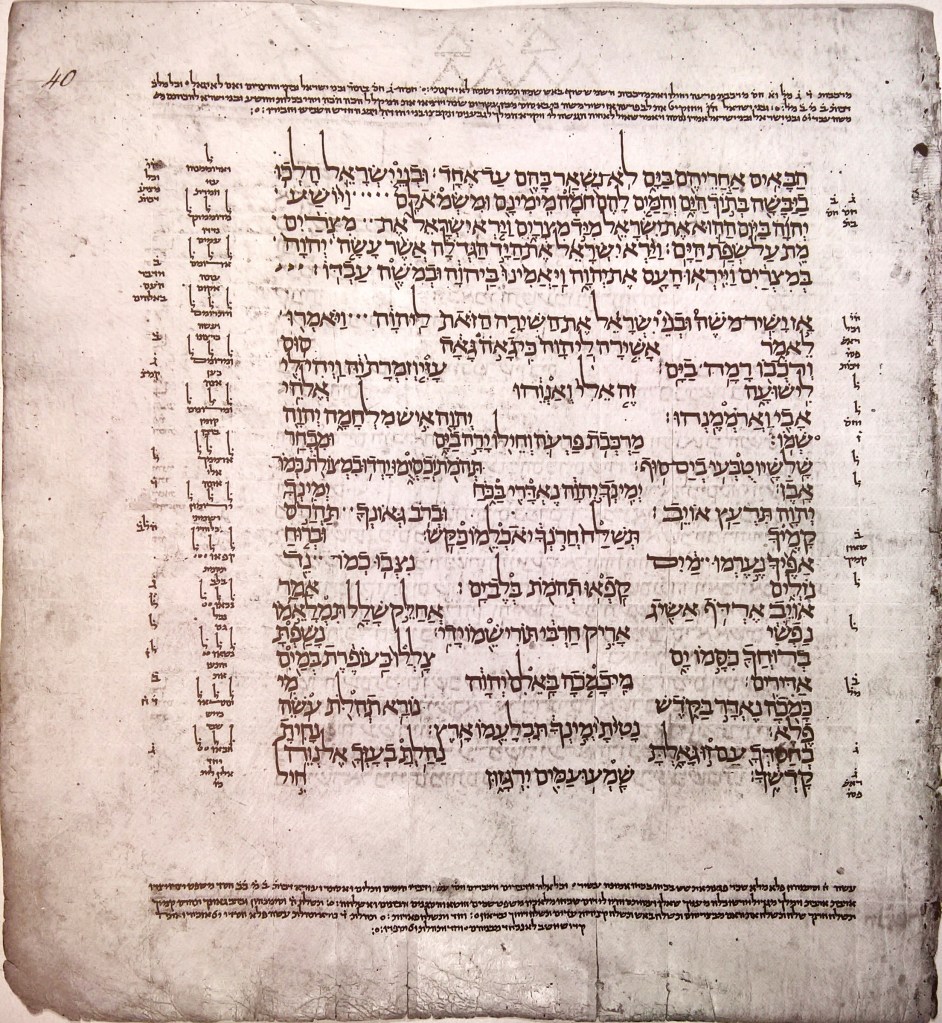
However, the Masoretic Text is not the oldest version of the Bible that we know (whether in Hebrew or another language). It is a product of the Middle Ages. That does not mean that the whole text stems from the Middle Ages. The consonantal text is older, but the stabilizing paratextual elements developed in the Middle Ages and appended and inserted into the text during that era. In fact, the oldest complete Manuscript of the whole Hebrew Bible is the so-called Leningrad Codex, Codex B19A of the State Library of St. Petersburg. It is from ca. 1008 CE (i.e., it is only about 1012 years old). Here is a picture from a facsimile edition, to give you some idea of what it looks like.

Codex Leningradensis. Folio 40 Recto. Source: David N. Freedman. Leningrad Codex. A Facsimile Edition. 1998.

This particular folio presents the end of Exodus 14 and the opening of Exodus 15, which is written with special formatting. Normally the text appears in justified columns without so many gaps (the breaks here should resemble bricks in a wall). The primary text is clearly recognizable in the middle with the paratextual elements surrounding it in the margins and the accents and vowels above and below the consontal text.

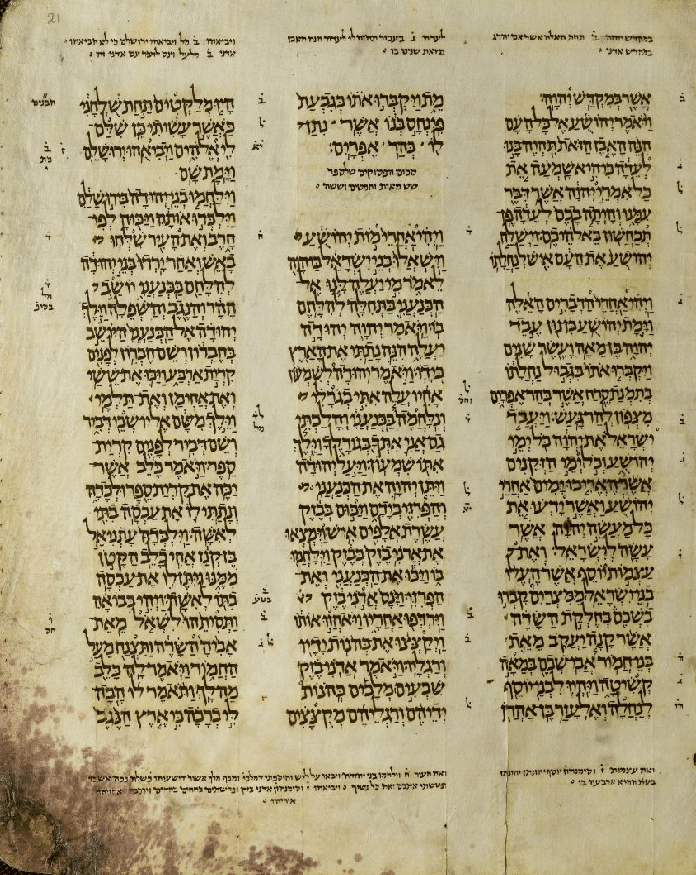
An older complete manuscript exists, but parts of it have been destroyed or gone missing. This is the so-called Aleppo Codex. The beginning and end (and some other pieces throughout) are now lacking and their status unknown, presumably destroyed. This version is about a century older than the Leningrad Codex, though from a related family of texts. Here is a picture.

Aleppo Codex. Joshua 24:26-Judges 1:15
Source: http://www.aleppocodex.org
Accessed on 11 October 2019

So, the oldest known complete biblical manuscripts in Hebrew are from the 10th-11th centuries of the Common Era, though there are older manuscripts of portions of the text (like the Torah or the Prophets). These oldest manuscripts attest a text from the Middle Ages. We can be pretty sure that the text has been remarkably stable since at least the fourth century CE, when Jerome translated the Bible into Latin from a consonantal Hebrew text almost identical to the text we know now. Nonetheless, we can say with some certainty that the consonantal text was pretty stable much earlier based on some finds from Qumran. Some of the biblical (and other) manuscripts from Qumran attest a consonantal text (these predate the existence of Masoretic vowels) similar or identical to the Masoretic text (though often with a distinct orthography), though other manuscripts demonstrate the textual fluidity of that period of transmission. That, however, merits a further blog post.

I hope this presents a clear, general overview of the Hebrew/Aramaic text that serves as the basis of modern translations of the Bible. It’s a younger text than many assume, but still a reliable text for much of what it records. Feel free to post comments or questions (though they will be moderated), particularly if there is something specific you want further information about.

  • Welcome to my blog!

    I hope you find the material here both entertaining and informative. Or at least one of those two. Or neither. Welcome to my blog!
  • Enter your email address to subscribe to this blog and receive notifications of new posts by email.

  • Follow Jonathan Robker: Exegete, Critic, Cook on WordPress.com
  • Archive

  • Twitter Timeline