And the King, David, was old. He came in the days. And they covered him with the blankets, but it was never warm for him.
And his servants said to him, “let them seek for my lord, the king, a young woman, a virgin, so that she can stand before the king, and she can be for him an official and lay in your lap and it will be warm for my lord, the king.”
And they sought a beautiful young woman in the whole territory of Israel, and they found Abishag the Shunamite, and they brought her to the king.
And the young woman was beautiful, even greatly so. And she became for the king an official and she served him, but the king did not know her.
Comments on the Text
Two observations merit mention in verse 1. First, syntactically, it appears as if David was added as an afterthought. The subject “the king David” is unwieldy and probably the product of editing. One notes in this vein, that David essentially vanishes from the text after this verse, which consistently refers to “the king” without mentioning a name. Second, the final phrase regarding the king’s inability to be warm appears in the imperfect, suggesting that it should be understood as an iterative. It is not that he is not warm only once; rather, he is never warm.
The woman the king’s servants propose to seek should fulfill two functions: she should serve him as an official (the term is otherwise used for someone like a chancellor in Isa 22:15) and also lay in his lap. That’s an exceptional combination of distinct services, to say the least. Only the latter has to do with verse 1.
The woman they eventually find in verse 3 is said to come from the territory of Shunem, known otherwise in the Bible as a town in the north of Israel and ascribed to the tribe of Issachar. This town may be mentioned in Egyptian correspondence from the Amarna period. Any identification of the site is currently insecure. Interesting here is that the king’s servants seek a woman for him in the north of Israel. If this is about David, who should be from the south, we see perhaps something of an imperialistic tendency, perhaps even an implied overreach, suggested in this action. More importantly: Abishag is found and brought to David. It is never suggested that she came willingly, at best, only passively.
Verse 4 initially focuses on Abishag’s appearance and notes that she is especially attractive. That could only have merit for one of her supposed functions for the king. The text does not even mention her name here, describing her only as “the young woman”; older translations preserve readings like “maid.” The verse continues, noting that she serves the king in some official capacity. Nonetheless, she never speaks in the Bible. Finally, the verse (and this brief passage) conclude with the notice that the king did not know her, i.e., he did not have sex with her. Two (perhaps not entirely mutually exclusive) options bear consideration here. Is the text trying to preserve the dignity of the king or the woman by stating that there was no physical intimacy between them? Or is the text mocking the king, saying he was impotent (in every sense of the word)? This second option is especially poignant, if the text was always about David, who had a somewhat voracious appetite for women (though not as ludicrous as that of his son and successor Solomon).
I wrote the following paragraph in the days before lockdown began in March 2020. Today (10 July 2020) I found a few minutes to look at my blog again and think about the future of what I’m going to be doing here.
As part of a commentary project I am working on, I will be translating the various versions of 1 Kings 1-15 (particularly Hebrew and Greek). These chapters present exegetes with a variety of problems, including its existing in a number of distinct variants. For the sake of access and gaining input, I have decided to put some preliminary translations of these chapters in the various versions online as I finish them. Where possible and desired, I will try to add comments on textual and other diachronic or tradition-historical issues. My request to readers: take a look at them and pose questions about their meaning and content. Also simple stuff like typos and what not. I would appreciate feedback from experts and laypeople alike, so give me your questions and comments.
This is a tricky one, but I think a fun one. Sometime in the third century BCE, someone decided that the Hebrew scriptures, at least the texts that ultimately became scripture and some others, should be translated into Greek. The legend goes that they were translated for the library of Alexandria at the behest of the Ptolemaic king of Egypt. He wanted a copy of every book in the world for his library. That, of course, would include the Hebrew scriptures of the Jewish community in Alexandria. For them to be understandable to the contemporary audience, they need to be translated into Greek. Thus, experts would be needed to translate the Hebrew texts into Greek. The legend continues that 70 (actually 72, i.e., six from each of the twelve “tribes of Israel”) men would translate the scriptures. Christian recensions of this legend recount that the 72 men translated for 72 days and – miraculously – all produced an identical Greek translation of the Hebrew text. The number 70 (in Greek) became the name for this translation: the Septuagint. (Cf. the most accurate adjective for all of the major-party candidates for president of the USA in the 2020 election: Septuagenarian.)
Obviously, not every element in this story can be regarded as historical. Additionally, not every element of the story is clearly defined. For example, it seems improbable that the whole of the scriptures was translated at once. It even seems unlikely that the first translation included the whole of the Torah, called “Pentateuch” in Greek, i.e., the first five books of the Bible, traditionally called the books of Moses. So, is there anything in the legend that is believable or trustworthy?
Linguistic analysis of the oldest (reconstructed) translations suggests that Egypt from about the third century BCE seems a likely historical circumstance for the beginning of the translation. However, the process of translating the Hebrew scriptures was ongoing and certainly not undertaken at only one time. It continued for centuries and even included revisions of older translations. It is questionable whether the translation of the Hebrew scriptures was initiated at the monarch’s behest. The historical circumstances permit it, at least. Perhaps it was initiated because of the construction of the library of Alexandria, making the monarch at least indirectly responsible. Alexandria was home to a large Jewish community at the time, so it seems likely that they might have initiated it in accord with the Zeitgeist. Another matter remains unclear: namely what the first translated text was, of what it consisted. That still remains a problem. Likely candidates are Genesis and Deuteronomy. And that brings us to another problem, to what does the term “Septuagint” refer?
The term’s original referent was to the initial translation of the Torah, i.e., the Pentateuch. Over time, the term lost some of its specificity and referred to the Greek translation of the whole of the Hebrew scriptures. Most use the term today to cover basically everything biblical in Greek that isn’t the New Testament. Due to the loss of specificity and clarity, scholars in the field have since begun to distinguish the terms they use. “Septuagint” can still basically refer to anything Greek and biblical that is not the New Testament. When referring to the original translation of a specific text or book, they now prefer the term “Old Greek”. This is necessary since some Greek translations, maybe all of them, have been revised and some, probably all, have been corrupted over the course of their transmission.
The corruption is easy to explain: when people copy texts, errors creep in. Texts are misread. Handwriting becomes illegible and difficult to read and copy. Copyist’s eyes skip over words and lines. Words get copied twice and so on.
More complicated are the revisions of the text. This occurs in limited contexts, on the one hand. That is, some superficial conscientious changes creep in to the text. Several reasons for this are readily recognizable: replacing one word with a more understandable or contemporary word, removing something that is ideological problematic (at least from the translator’s or editor’s perspective), avoiding difficulty in a text, revising towards internal or external consistency within a body of works, and so on. The Old Greek, as far is it has been reconstructed to date, has many such revisions throughout its text. (One should not overstate this, though; taken on a whole probably 98% of the Old Greek’s text reflects a Hebrew text consistent with the Masoretic Text, at least in books that do not have markedly distinct Greek versions like Exodus, Samuel, Kings, and Jeremiah.)
On the other hand, several of these revisions, present even essentially new translations of the Hebrew into Greek. Such broad revisions are historically documented with distinct monikers even from Antiquity. One such larger school of revision was only identified in Modernity. Ironically, it is probably the oldest revision that we now recognize. Some of these revisions occurred within Jewish circles, while others were undertaking by Christians. To the terminology: in general, scholars refer to these larger, distinct revisions as “recensions” and identify most of them with the names of specific individuals with whom they have historically been associated. Here’s a graphic that I made to describe the relationship of these various recensions to the Old Greek, to the Hebrew, and to each other for one of the more complicated cases in the Bible’s textual history: Samuel and Kings.
Overview of the general textual history of Samuel and Kings
This graphic reflects a few different points. The black line along the top represents the development of the Hebrew parent text with the boxes representing distinct phases or versions of that text. The red material all reflects Greek translations or revisions of the Greek text from the first Greek translation of the Hebrew (i.e., “the Old Greek”). The dotted red lines reflect postulated influence or development from one Greek version to another. The distance between the red and black lines represents the proximity of the versions to one another. That is, the closer a red version is to the black line, the more closely it reflects its Hebrew parent text. For example, generally, the Old Greek of Kings seems to be good translation Greek, that is, Greek that is obviously a translation and not a compositional Greek. It generally follows the strictures of good Greek grammar and would have been cogent for native Greek speakers, if somewhat curious in its phrasing and syntax. The kaige elements of Kings are much closer to the Hebrew text and often reflect elements of the Hebrew that are superfluous or even damaging to the Greek. An example will hopefully suffice: Hebrew has two words for the first-person singular pronoun “I”, אנכי and אני. These two terms, one longer than the other by one consonant/syllable, are semantically identical. They bear no distinction on the understanding of a text. However, the kaige translator(s) distinguished between these two terms in Greek, translating the short form with ἐγώ (“I”) and the long form with ἐγώ ειμι (“I am”), even when it was followed by a finite verb and therefore incomprehensible in Greek. (That would be like the difference between “I go” and “I am go” in English; the first makes sense, the second does not.)
But why is all of this in a discussion about the Septuagint? Well, with time, the term “Septuagint” changed from referring to the Greek translation of the Torah (i.e., “the Pentateuch”), to the Greek translation of each book in the Hebrew canon, to basically everything biblical in Greek, but not the New Testament (which is, of course, also in Greek), including all of the different versions and recensions of the Greek text. What is more, these versions were known, at least some of them, in Antiquity and were recognized as distinct. Origen collected and collated different versions in a monumental text-critical project called the “Hexapla”. There, he transmitted no fewer than four Greek versions of the Bible: his version of the “Old Greek” (wherever he had gotten that from) and the recensions of Aquila, Symmachus, and Theodotion. It also included a column with the Hebrew text as well as a column with a transliteration of the Hebrew with Greek letters. In the preface to his translation of Chronicles, Jerome mentions three Greek recensions known to him, including those of Origen and Lucian.
So, the recognition of different versions of the Bible is something that even the ancients were aware of. The idea that the biblical text never changed with time or was identical in every case is a modern idea, actually a reaction to Darwinism in its most vociferous forms and, therefore, quite recent – from the perspective of ancient Near Eastern literature. None of these various Greek versions is identical to another. And none of them is identical to the Hebrew text we know from the Medieval manuscripts of the Masoretic tradition or other known Hebrew manuscripts (such as the Dead Sea Scrolls). The moral of this particular post, however, remains within the confines of the Greek text: be careful when people tell you about “the Septuagint”. Find out what that means to them, to what they are referring. The odds are, they haven’t thought much about it. The Septuagint is an unknown quantity to us. The best that we have are some manuscripts that agree across the vast majority of their text (although not necessarily in the same way for every book in what became the canon), as well as academically recreated, modern postulates based on these manuscripts (in addition to principles the editors may in some instances apply to the text).
In conclusion then, the question at the outset: What is the Septuagint? Well, it depends on whom you ask. Sorry about that.
Recently, I have encountered a number of tweets about biblical transmission and some YouTube videos about “the Original Hebrew Bible” as contrasted to the Masoretic Text or the Septuagint. (I’m not going to link them, since they’re offensive, innaccurate, dangerous, or some combination of these and I don’t want them to get views etc.) I think that it is important for people to know where the Bible they read came from, particularly if they are going to regard it as “holy scripture” or similar. Since this is a field that I happen to know something about, I thought that I could write some notes here for anyone interested in an extremely simplified overview in the matters for laypeople (or experts who want to argue with me). This will have to be a series. The best place to start is with the Hebrew text that serves as the basis of most modern English translations (as well as those of many other modern languages) of the Bible.
Part 1: The Masoretic Text (Hebrew)
Most modern English translations of the Hebrew Bible (the Jewish Tanakh or the Christian Old Testament) are based primarily on a textual tradition known as “the Masoretic Text”. This refers not to an individual manuscript, as many seem to think, but rather to a substantial group of Hebrew manuscripts (with some small portions of the text in Aramaic) that attest essentially the same consonantal Hebrew/Aramaic text as well as paratextual elements. It is important to emphasize that “the Masoretic Text” refers not to a specific manuscript, but is an abbreviation for a larger group of more or less consistent manscripts. The paratextual elements consist of vowels, accents, and marginalia. These paratextual elements serve a few important purposes, but the most important (for my purposes, at lesat) is securing the text to prevent errors from creeping in when the text is copied from one manuscript to another. To this end, the paratextual elements note things like unusual grammatical forms or orthography, the number of verses in the book, where the midpoint of the book is, wordcounts, recommendations for correcting or understanding the text, etc. For this reason, the Masoretic textual tradition is remarkably stable and an excellent tradition for the basis of the translation and study of the primary religious text of the Jews and one portion of the Christians’ canon.
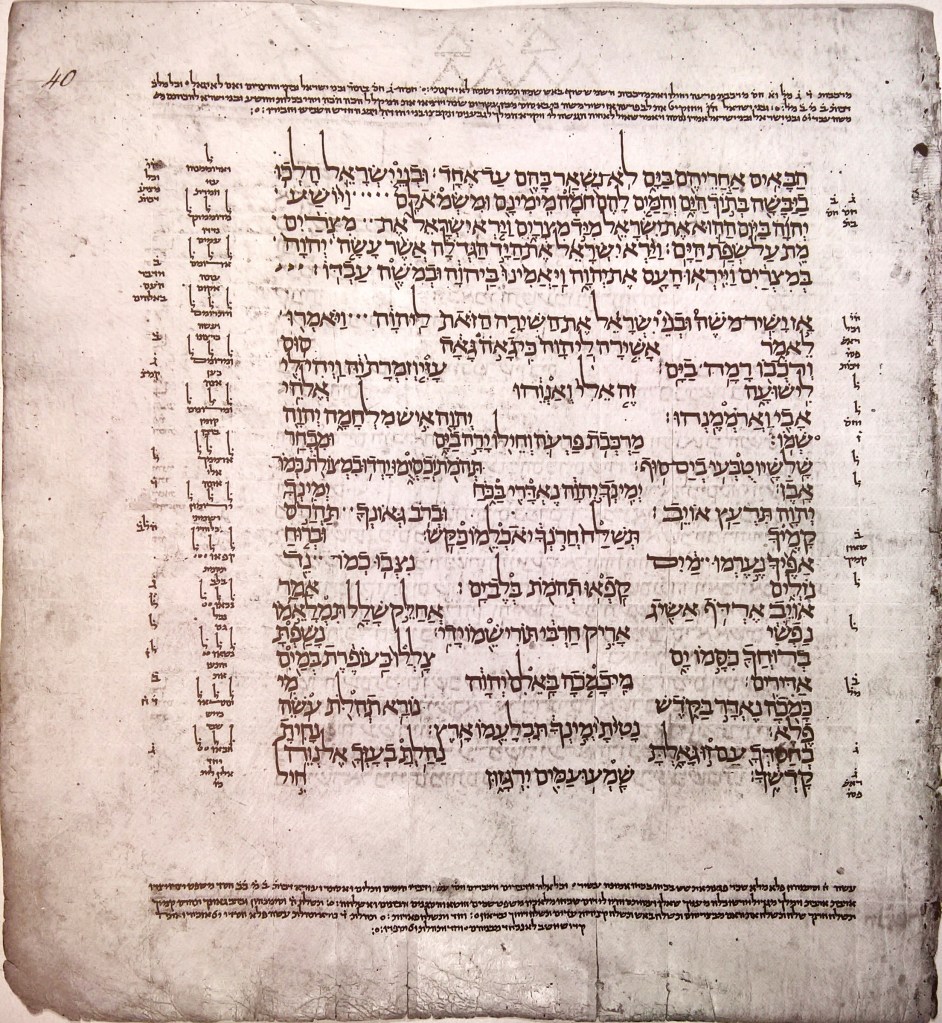
However, the Masoretic Text is not the oldest version of the Bible that we know (whether in Hebrew or another language). It is a product of the Middle Ages. That does not mean that the whole text stems from the Middle Ages. The consonantal text is older, but the stabilizing paratextual elements developed in the Middle Ages and appended and inserted into the text during that era. In fact, the oldest complete Manuscript of the whole Hebrew Bible is the so-called Leningrad Codex, Codex B19A of the State Library of St. Petersburg. It is from ca. 1008 CE (i.e., it is only about 1012 years old). Here is a picture from a facsimile edition, to give you some idea of what it looks like.
Codex Leningradensis. Folio 40 Recto. Source: David N. Freedman. Leningrad Codex. A Facsimile Edition. 1998.
This particular folio presents the end of Exodus 14 and the opening of Exodus 15, which is written with special formatting. Normally the text appears in justified columns without so many gaps (the breaks here should resemble bricks in a wall). The primary text is clearly recognizable in the middle with the paratextual elements surrounding it in the margins and the accents and vowels above and below the consontal text.
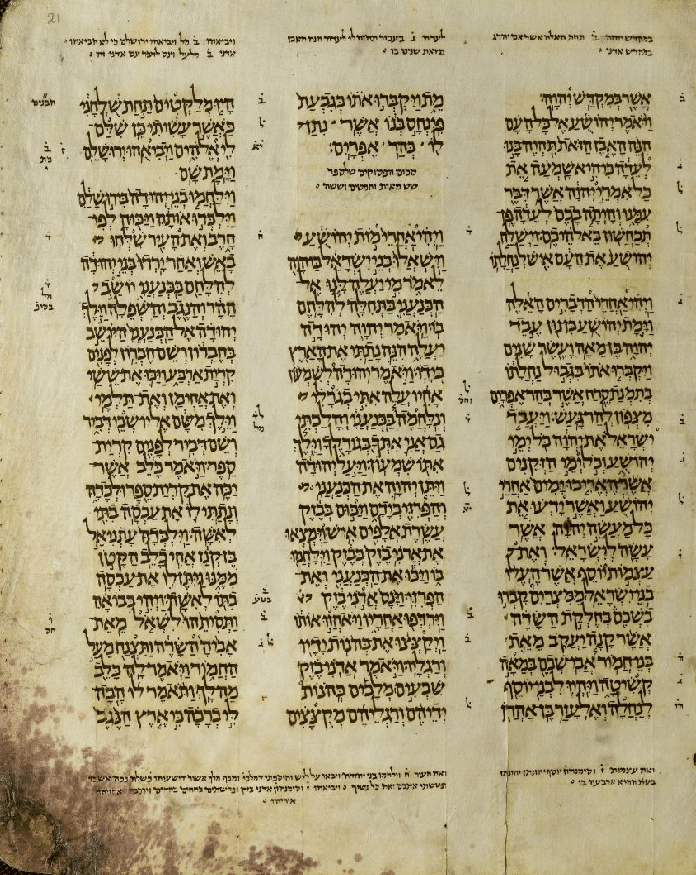
An older complete manuscript exists, but parts of it have been destroyed or gone missing. This is the so-called Aleppo Codex. The beginning and end (and some other pieces throughout) are now lacking and their status unknown, presumably destroyed. This version is about a century older than the Leningrad Codex, though from a related family of texts. Here is a picture.
So, the oldest known complete biblical manuscripts in Hebrew are from the 10th-11th centuries of the Common Era, though there are older manuscripts of portions of the text (like the Torah or the Prophets). These oldest manuscripts attest a text from the Middle Ages. We can be pretty sure that the text has been remarkably stable since at least the fourth century CE, when Jerome translated the Bible into Latin from a consonantal Hebrew text almost identical to the text we know now. Nonetheless, we can say with some certainty that the consonantal text was pretty stable much earlier based on some finds from Qumran. Some of the biblical (and other) manuscripts from Qumran attest a consonantal text (these predate the existence of Masoretic vowels) similar or identical to the Masoretic text (though often with a distinct orthography), though other manuscripts demonstrate the textual fluidity of that period of transmission. That, however, merits a further blog post.
I hope this presents a clear, general overview of the Hebrew/Aramaic text that serves as the basis of modern translations of the Bible. It’s a younger text than many assume, but still a reliable text for much of what it records. Feel free to post comments or questions (though they will be moderated), particularly if there is something specific you want further information about.
My plan for this blog post was originally going to be something thematic related to my field of work and research. However, due to an illness that I was still recovering from over the past two days, I didn’t have time to prepare the actual content that I wanted to cover. That’s also because today was Wednesday, and Wednesday is special in our college (German: Fakultät). On Wednesday, we have meetings, which means we don’t get much work done on actual content. In a few words, I wanted to describe what a typical Wednesday looks like for me. Perhaps you’ll see why I sometimes struggle with academia undertaken in this fashion.
6:25: Leave the apartment to catch the bus (I read The Economist at the bus stop and on the bus)
6:45: Arrive in my office (usually only the cleaning crew is there when I arrive, sometimes other custodial staff, as was the case today)
6:45-8:00: review material for dissertation candidates from our college (I did the required reading before Christmas)
8:00-8:20: breakfast
8:20-9:00: correspondence (usually email, sometimes Skype or snail mail)
9:00-10:00: generate final exams for students
10:00-10:20: break for stretching with a quick stroll to the bakery to pick up something for lunch (I didn’t have room in my bag to bring something from home)
10:20-11:15: plan conference attendances and possible paper topics (this is a special matter only at this time of year)
11:15-12:00: meet with the dean to preview topics for faculty council meeting next week
12:00-12:15: eat my sandwich
12:15-13:00: meet with the committee for finance and personnel (planned to last until 14:15, but we finished early)
13:00-14:15: spontaneous meeting with my boss to plan and strategize for an important meeting next week and layout our exams schedule (we also caught up on how the holidays were)
14:15-15:15: doctoral committee (was planned to go until 16:00, but due to an unforeseen paucity of contentious issues, we finished early)
15:15-16:15: further correspondence, refresh the to-do list for the rest of the semester
16:15: catch the bus home (and continue reading The Economist)
From this list, it should be pretty clear that I accomplished no substantial academic work or research today. Without a doubt, much of this is important work for the future of or college, but some of it is also clearly planning to plan. In my opinion, this presents one of the great hurdles in academic life these days. All of the time that I spend in meetings is time that I am not spending reading, thinking, writing, publishing, preparing lessons, advising students, or teaching. Germans call this akademische Selbstverwaltung (“academic self-administration”), and it features prominently in the scholarly landscape here. I’d be particularly interested in hearing how this is in other academic cultures. Is it similar?
The schedule I described (generally) only reflects Wednesdays. Nonetheless, it describes a typical Wednesday, which still represents 20% of my working week (and the working week of everyone else in all of these committees). My hope is that we can someday move some of this online (many meetings could have been an email) or at least move them to rooms that don’t have chairs. (I assume if everyone had to stand, meetings would go much faster. We could even make them go faster still by holding them while walking.)
That’s all I have time for now, since my daughter just got back from her play-date and is looking to catch up with me.
Translation:
1) YHWH spoke to Moses in the desert of Sinai in the tent of meeting on the first of the second month in the second year of their exiting the land of Egypt, saying
2) “Count the heads of the whole assembly of the sons of Israel according to their tribes and their fathers’ houses, according to the number of names, every male according to their heads [lit. “their skulls”],
3) From every one twenty years old or older, everyone coming out to fight in Israel, you should muster them for their fighting, you and Aaron.
4) Each will be with you, each for his tribe. Each shall be the head of the house of his fathers.
5) And these will be the names of the men who will stand with you: For Reuben: Elizur ben Shedeur;
6) For Simeon: Shelumiel ben Zurishadai;
7) For Judah: Nachshon ben Amminadab;
8) For Issachar: Nathanel ben Zoar;
9) For Zebulon: Elion ben Chelon;
10) For the sons of Joseph, for Ephraim: Elishama ben Ammihud; for Manasseh: Gamliel ben Pedazur;
11) For Benjamin: Abidan ben Gideon;
12) For Dan: Achiezer ben Ammishadai;
13) For Asher: Pagiel ben Ochran;
14) For Gad: Elyasaph ben Deuel;
15) For Naphtali: Achira ben Enan.
16) These are those called from the assembly, men of the tribes of their fathers; heads of the thousands of Israel are they.”
17) So Moses and Aaron took these men, who had been called by name.
18) And the whole assembly they called together on the first of the month of the second year. And they were registered in the list of generations according to the tribes of the house of their fathers, according to the number of names from those twenty years old or older according to skulls,
19) Just as YHWH commanded Moses. And he assembled them in the desert of Sinai.
20) And these were the sons of Reuben, Israel’s firstborn, their generations according to their tribes, according to the house of their fathers, according to the number of names every male according to their heads [lit. “their skulls”] twenty years old or older, everyone who came out to fight.
21) Their assembly of the tribe of Reuben: 46500
22) Belonging to the sons of Simeon, their generations according to their tribes, according to the house of their fathers, according to the number of names, according to their skulls, every male twenty years old or older, everyone who came out to fight.
23) Their assembly of the tribe of Simeon: 59300
24) Belonging to the sons of Gad, their generations according to their tribes, according to the house of their fathers, according to the number of names, twenty years old or older, everyone who came out to fight.
25) Their assembly of the tribe of Gad: 45650
26) Belonging to the sons of Judah, their generations according to their tribes, according to the house of their fathers, according to the number of names, according to their skulls, every male twenty years old or older, everyone who came out to fight.
27) Their assembly of the tribe of Judah: 74600
28) Belonging to the sons of Issachar, their generations according to their tribes, according to the house of their fathers, according to the number of names, according to their skulls, every male twenty years old or older, everyone who came out to fight.
29) Their assembly of the tribe of Issachar: 54400
30) Belonging to the sons of Zebulon, their generations according to their tribes, according to the house of their fathers, according to the number of names, according to their skulls, every male twenty years old or older, everyone who came out to fight.
31) Their assembly of the tribe of Issachar: 57400
32) Belonging to the sons of Joseph, belonging to the sons of Ephraim, their generations according to their tribes, according to the house of their fathers, according to the number of names, according to their skulls, every male twenty years old or older, everyone who came out to fight.
33) Their assembly of the tribe of Ephraim: 40500
34) Belonging to the sons of Manasseh, their generations according to their tribes, according to the house of their fathers, according to the number of names, according to their skulls, every male twenty years old or older, everyone who came out to fight.
35) Their assembly of the tribe of Manasseh: 32200
36) Belonging to the sons of Benjamin, their generations according to their tribes, according to the house of their fathers, according to the number of names, according to their skulls, every male twenty years old or older, everyone who came out to fight.
37) Their assembly of the tribe of Benjamin: 354000
38) Belonging to the sons of Dan, their generations according to their tribes, according to the house of their fathers, according to the number of names, according to their skulls, every male twenty years old or older, everyone who came out to fight.
39) Their assembly of the tribe of Dan: 62700
40) Belonging to the sons of Asher, their generations according to their tribes, according to the house of their fathers, according to the number of names, according to their skulls, every male twenty years old or older, everyone who came out to fight.
41) Their assembly of the tribe of Asher: 41500
42) Belonging to the sons of Naphtali, their generations according to their tribes, according to the house of their fathers, according to the number of names, according to their skulls, every male twenty years old or older, everyone who came out to fight.
43) Their assembly of the tribe of Naphtali: 56400
44) These are those assembled, who Moses and Aaron assembled. And the princes of Israel were twelve men, one man for each tribe. Each tribe belonged to the house of his fathers.
45) The whole of the assembly of the sons of Israel for their battling, from twenty years and older, all who came out to fight in Israel
46) And all those who had been assembled were 603550.
47) But the Levites were not assembled according to the tribe of their fathers in their midst.
48) And YHWH spoke to Moses, saying,
49) “Indeed, you should not assemble the tribe of Levi and – their heads – you should not count them in the midst of Israel.
50) You should count the Levites before the dwelling of the community and before all the instruments and before all that belongs to it [i.e., the dwelling]. And they will carry the dwelling and all of the instruments and they will service them. Around the dwelling they will bivouac.
51) And when they break camp, the Levites will take down the dwelling. When they make camp, the Levites will set up the dwelling. But anyone not permitted who approaches will die.
52) The sons of Israel will camp, one was at the camping place, and the other at his emblem for their battle assembly.
53) But the Levites shall camp around the dwelling of the community so that the anger of YHWH will not be against the community of the sons of Israel.” So the Levites undertook guardianship of the dwelling of the community.
54) So the sons of Israel did just as YHWH commanded Moses and Aaron. Thus they did.
Text Critical Information:
V. 2: “whole” is missing in the Samaritan Pentateuch.
V. 3: “You” in the Masoretic text is plural, but the Samaritan and Syriac versions read the singular.
V. 18: Text emended to include “the second year” as in LXX.
V. 20: Text emended to match v. 1, the Samaritan text, and the Peshitta.
V. 22: The text has been abbreviated to match the best witnesses.
V. 42: The preposition translated as “belonging to” is missing in Codex Leningradensis, but attested in the best witnesses.
V. 44: Emend to read with LXX and the Samaritan text.
V. 45: Text Emended to follow LXX and the Samaritan text.
V. 54: LXX adds “and Aaron,” which has been used here.
Brief Commentary on the Text: The condition of the Masoretic Text makes a pretty good impression in Numbers 1. While I have not commented on every text critical matter published in the ciritical edition, the most important have been reflected here. The translation does not read very smoothly. The Hebrew syntax is quite lengthy for a narrative text and it is somewhat unclear at first glance why so many designations for the people who were to be counted were used. Curious is also the use of “skulls” in the categorization of those who are to be counted. This text can generally be regarded as a unity; there is nothing on the surface that necessitates or mandates a division of the text into multiple sources in this verse. On the surface, the immediate priority of the Levites over the rest of the tribes jumps out. Since the text ends with the handling of the Levites and does not even really count them among the other “sons of Israel”, one recognizes a strong emphasis on that group. This emphasis will presumably be expounded in other texts in the book of Numbers.
So, lots of people ask me what it is that I actually do all the time. I figured this would be a good enough venue to write about that a bit and provide some concrete examples of what is up.
My life currently consists of the following elements: 1) limited social engagements (to my friends in Erlangen: “Servus!”); 2) researching the redactional history of the Pentateuch; 3) compiling a research project covering the text history of the dodekapropheton; 4) studying for my PhD oral exams (rapidly approaching on May 30, 2011); and 5) watching Scrubs and a variety of films on DVD.
Most people can probably associate something with numbers 1, 4 and 5, but perhaps not as much with 2 and 3, so I’ll offer a little bit more about them.
To 2): This is part of a research project that I am working on with the University of Essen under the tutelage of Professor Dr. Aaron Schart in combination with the Universities of Bochum (Professor Dr. Christian Frevel) and Dortmund (Professor Dr. Thomas Pola). What are we researching? The redaction history of the Pentateuch, most especially as it relates to the book of Numbers. Now that sentence probably requires a little explanation. I don’t know who’s reading this, but I’ll assume that not everyone is familiar with these terms. What is the Pentateuch? Rather than send you to Wikipedia to look it up, I’ll tell you that the term “Pentateuch” refers to the first five books of the Bible (whether in the Jewish or Christian canon), commonly called the Torah in the Jewish canon and traditionally associated with Moses, i.e. until about the 18th century most, but certainly not all, people generally accepted the precept that Moses wrote these five books. Even in antiquity Jewish scholars began to have some problems with this notion, as Deuteronomy 34 describes Moses’ death, and someone writing about his or her own death and burial is, as far as I know, still unknown from any historical personage. At any rate, the name Pentateuch comes from the combination of two Greek words, πεντα and τευχος, meaning “five” and “book” respectively. Thus, the namely Pentateuch means “Fiver-Book” because of its division into five parts, commonly known in English by the names Genesis, Exodus, Leviticus, Numbers, and Deuteronomy.
Regarding the Pentateuch, we are focusing on redaction history. What that references is the way that the Pentateuch developed. Contrary to the opinion of some, the evidence strongly suggests that the Bible did not fall from the sky in its current form, but grew over a process of centuries into the amazing example of theological discourse spanning hundreds (if not thousands) of years that we find before us today. In the late pre-Modern period, people – not all of them theologians – began to notice tensions within the text of the Pentateuch which led them to postulate a variety of sources and redactional levels in the text. By redactional material, we generally refer to portions of the text added by an editor and not coming from source material. A general concensus began to develop over the course of the 19th and early 20th centuries about what material came from which source, how the sources were chronologically related to one another, when they were added together, and what material came from the person(s) responsible for that textual editing. During the later twentieth century, especially in the last third, this consensus collapsed, especially in the continental European context. Now there are a variety of theories running the gamut from total atomization of the text (i.e. it is next to impossible to discern how many people took part in the writing and composing over how many centuries) to the text coming largely from a single author or a few authors, composing at a very late period. This research project hopes to tackle the problem in a new way, setting the book of Numbers as our starting point.
Why the book of Numbers? Well, the problem with Numbers is that it doesn’t really fit well into anybody’s theory. Numbers is a disparate work with material from a variety of genres and sometimes really barely seems to make sense (though loads of these problems have been removed from translations into English). This problem has led some to conclude that Numbers became kind of a catch all for the rest of the material that people wanted to put into the Torah and didn’t know where else to do it. I disagree with this opinion because I find it largely a cop-out and a devaluation of the traditions in the book. What I am not sure of is what theory better explains the circumstances, and thus, it’s appropriate that I take part in a research project researching this matter. If you take one thing from this blog entry though, it should be the impetus to sit down and read Numbers; there is some crazy stuff going on in that book.
To 3): What in the world is a “Dodekapropheton”? Well, we only have one of them, at least as far as I have ever discovered. It refers to the book of the Twelve Prophets, also known as the Twelve Minor Prophets. In the Christian canon they are the last books of the Old Testament, whereas in the Jewish canon, they conclude the prophetic materials and precede the Writings. These poor prophets are not called minor because they lack import – Amos and Hosea are my personal favorites – but rather because the books are vastly shorter than those of some of their prophetic colleagues, namely Isaiah, Jeremiah, and Ezekiel. If you have any background in the Christian or Jewish tradition, you have most likely heard of these three. (At least growing up in the United States, you should know the name Isaiah from Isaiah Thomas, Jeremiah the bullfrog, and Ezekiel from Weird Al) The other prophets are the ones that many, or most, have never heard of. Like if I were to tell you that there is a prophet in the Bible named Habakkuk, you probably wouldn’t believe me, but you know what, he’s in there, just like Obadiah, Zephaniah, Nahum, and some other fun names. Look it up.
The Twelve Minor Prophets have been considered to be a single book since antiquity. Evidence from Qumran suggests that, at the latest, the Twelve were regarded as one book in the century before the Common Era. The name Dodekapropheton, like Pentateuch, comes from two Greek words: δωδεκα, which of course all of my D&D friends will recognize as meaning “twelve” (as in dodekahedron, as in being shaped like a 12-sided die [oh yeah, now I finally understand that Weezer lyric]) and, well, I imagine you can figure out the rest. It means Prophet (or better Prophet-Book).
Rather than focus on the redaction history of the Book of the Twelve, this project focuses on the textual history. As I mentioned before, the Bible didn’t fall from the sky in its current form – and even if it had, we have the problem that tons of people starting copying and translating it so that no two manuscripts are identical. That presents a problem, namely what is “The” Bible. This project tries to get behind some of that and see who is copying what, when, and where. Where there are differences in the text – and there are differences in the text, even though more often than not, they are minor – these differences should be explained. Was it a scribal error? Was there another version of the text being copied or translated? Did the scribe copying or translating change the text? Why? Can specific linguistic or ideological profiles be established for the people doing this work? This is the kind of stuff that I do.
So, that’s a little bit of behind the scenes. I hope to write more about the specifics of my work in the future and bring in some of the academic dialogue running in the background. Maybe you’ll find it as interesting as I do.
After four and a half years in Erlangen, Germany working in the Institute for Old Testament there and finishing my dissertation, I have moved to Wuppertal, Germany. Here, I’ll be working for Prof. Kreuzer in Wuppertal and for Prof. Schart in Essen, working on research projects and composing proposals for stipends to pay for the expansions of these research projects.
I’m pretty excited about the new opportunities here, although I’m a little disappointed that I haven’t finished my PhD yet. Due to circumstances beyond my control, I had to move here before everything in Erlangen was finalized, meaning that I get to pay the 120 Euro to go back in April or May to take my oral exams. No need to complain about it, I just wish that I had been able to finish that off and start off here with a clean slate.
At any rate, I have spent the last week getting to know the material for the research that we are undertaking here, as well as aquainting myself with the environs. Both of the professors here are really interested in supporting me thus far and have really gone out of their ways to make sure that everything gets moving. That makes the research that much more appealing, but I’m really excited about it simply because the subjects are huge, detailed, and currently hot spots in the world of academia.
At the present, I have been doing some correcting work and assisting in the composition of the indices for Explanatory Volume of LXX.D (Septuaginta Deutsch), spending my afternoons looking up the various names of the Qumran texts and the various papyri that LXX.D references in its discusions of the various attestations of Greek forms or their Hebrew equivalents. Since the new volume has more than 3000 pages, it’s pretty tedious work, but I think that I have done a good job and will hopefully have helped scholars look up the materials that they seek.
On the other hand, I have been doing some research to get ready for a conference called “Torah in the Book of Numbers” that will be taking place on April 12-13, 2011 in Bochum, Germany. I’m trying to catch up on the newest and the classical positions on the Book of Numbers and the development of the Pentateuch/Torah. Since the people coming to present at this conference are great international scholars, I’m really looking forward to it. The singular problem is that there is way too much material to cover by then, that I could never ever possibly read it all. Write now I am working my way through the materials of Joel S. Baden, whose work I don’t know at all. He has some interesting positions, and I’m really looking forward to how he develops his thesis.
Eventually I hope to get some more research done on my next planned project: the Dodekapropheton (The Twelve Minor Prophets). However, if I start to love all of the research in the Pentateuch, I may find it hard to get back out of it. We’ll just have to see how it develops…
It would seem that I may have finished the assignment that my Professor gave me for this week. At least, I think I have done a pretty good job putting together what he wants from me. It is a start at any rate. If I understood him properly, he wanted me to write a literary history of the Book of Kings. That doesn’t sound too hard, but it is probably one of the most discussed topics in the last 50 years of Old Testament research. At any rate, I have my plan ironed out a bit, and it isn’t looking too shabby. Now I just have to get some more of the individual pericopes analyzed and it should be all good. The dissertation will be able to finish itself.
Realizing now that that previous paragraph makes it sound like I got lots of work done today, I need to edit what I said above. Basically, this morning I got a few hours of work in. And another couple this afternoon/evening. For the greater part of the day I was shopping and relaxing with Anja, now that she is back again. I picked up some new movies and we are going to watch one or two tonight (most likely Batman Begins, which I’ve never seen in English and Anja has never seen). Now I am about to head downstairs and get dinner ready so that we can enjoy that while we watch the film.
Today, I also thought that I would recommend some literature for people who may want to get an overview of how I spend my life. Today’s recommended book is The So-Called Deuteronomistic History by Thomas Römer. This book provides a pretty good overview of the weird stuff that I do all day. I hope that you enjoy it.


 Jonathan Robker: Exegete, Critic, Cook